welcome back to a walk through the tarot – this is card 2 – the high priestess –
we’re following the tarot fool as he journeys through the cards and meets the archetypes that shape our lives.
in the last video, the fool met the tarot magician. He learned about the power of creative energy and was drawn to the life and vitality of the card.
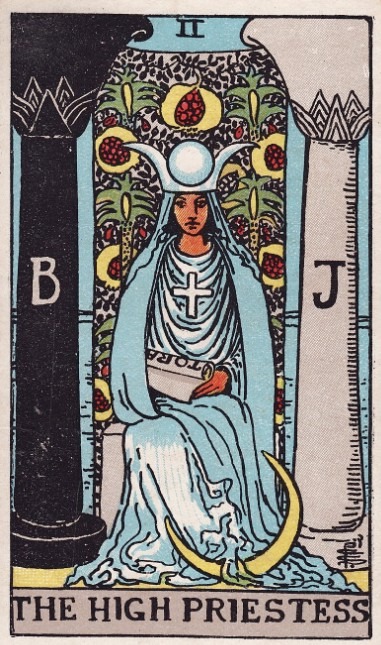
The high priestess is very different. Cool and detached, she sits in front of a veil, strung between two pillars, hiding what lies behind.
There’s a glimpse of water but nothing more.
She is the power of the unconscious mind. She represents depth, everything hidden below the surface. Her domains are the moon and oceans, both with power of their own
There’s a lot going on in this card.
We’re going to look at its background, explore the symbols and see what messages she has for the fool, as he continues with his journey.
Background to the high priestess
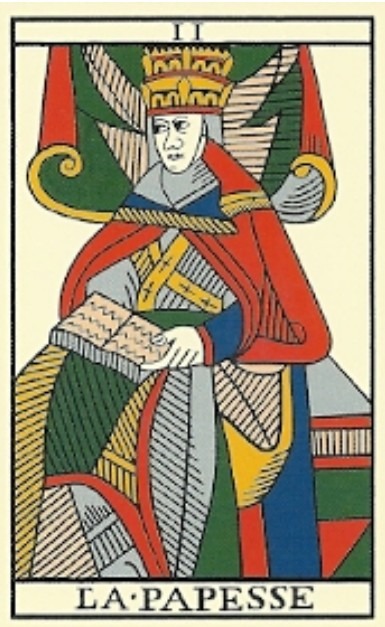
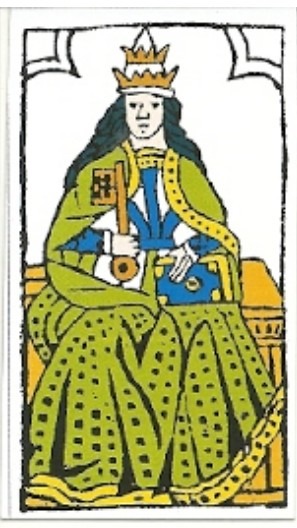
In early tarots she was called the paypess or female pope. A statue in St Peter’s church in Rome shows a woman wearing a bishops hat and holding the keys of heaven, or St Peters keys – a symbol of papal authority.
In the 14th century a popular story about a female pope, called Joan, claimed she disguised herself as male and was elected to popedom but her secret came to light when she gave birth during a papal procession. It’s now thought to be fiction but it shows how early tarot mirrored the culture and beliefs of the day.
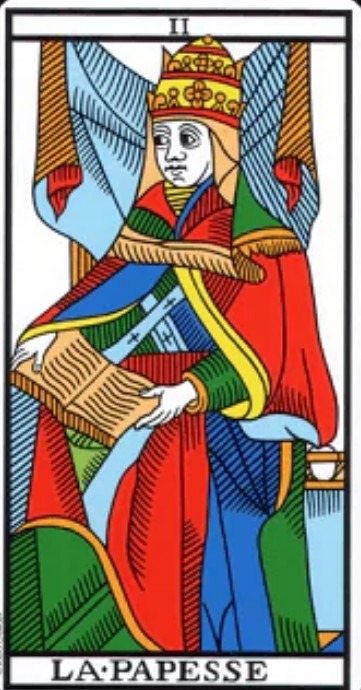
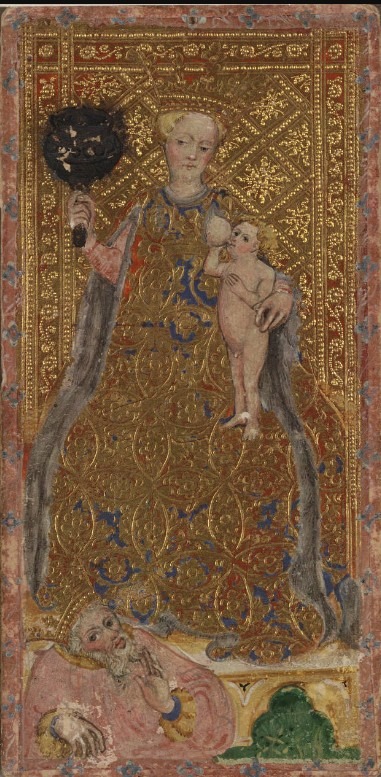
Some say the Visconti Sforza decks from the late 1400’s, might show sister Manfreda , a nun who was burned to death by the church on a charge of heresy. Manfreda was related to the Viscontis’ and, at a time when the catholic church had great power, it seems unlikely the Duke of Milan would publicise his family connections to a heretic but it might also have been a subtle acknowledgement of her life.
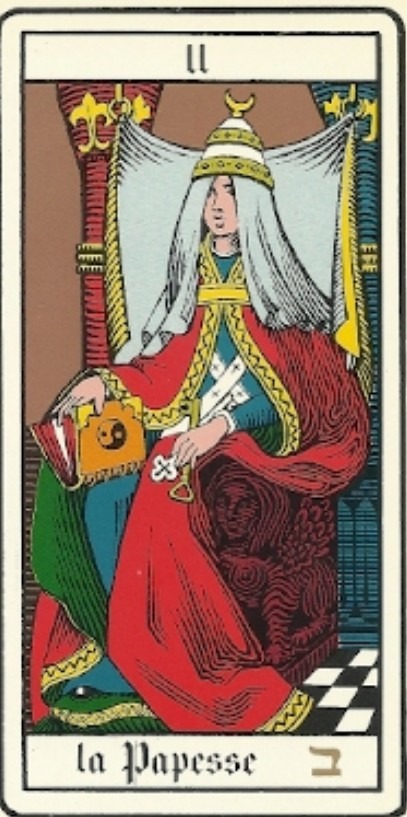
The card remained the paypess until tarot was adopted by French occultists in the 18th and 19th centuries. In his book, Le Monde Primitif (or The Primitive World), published in 1781, Antoine Court de Gébelin claimed tarot originated in ancient Egypt. With no evidence to support this, he renamed the card the high priestess, after the Egyptian goddess Isis, divine mother of Horus, and protector of the people.
She began to lose her catholic regalia. Out went the bishops crook and keys and in came the moon and the temple. The high priestess was becoming more pagan than catholic.
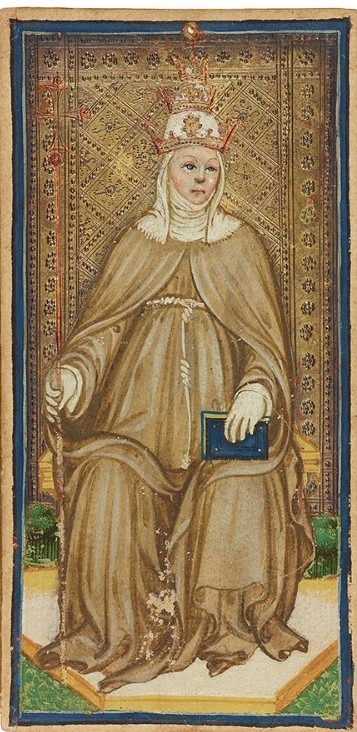
The archetype can be found in many older civilisations.
At Delphi in northern Greece, the high priestess at the Temple of Apollo was known as the Pythia. She sat on a 3-legged stool over a fissure in the bedrock where friction between the fault lines produced gases including ethylene and, breathing this in, would help her make prophecies.
Over the entrance to the temple were the words Know Thyself , a core message from the high priestess who represents the unconscious parts of ourselves we are often unaware of.
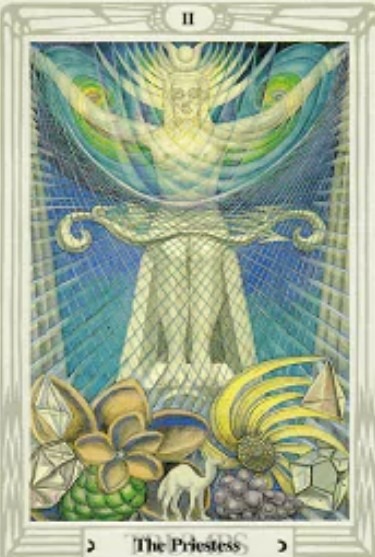
During the 19th century, Eliphas Levi wrote Transcendental Magic (1856). Like de Gébelin, Levi also interpreted the high priestess as the egyptian goddess Isis. She wore a solar cross and represented the guardian of inner mysteries, associated with the moon, and in possession of esoteric knowledge and secrets.
Today she remains a symbol of pagan femininity; more a goddess than a female pope or saint.
The Waite/Coleman Smith high priestess combines these ideas. Waite suggested a connection to the ancient cult of Astarte, who was also connected to war and conflict, and related to the Sumerian goddess Ishtar. Our high priestess could now be dated back to the 3rd millenium BC.
The twin black and white pillars emphasised her role as the keeper of secrets. As a representation of the divine feminine, she is often interpreted as having the power of a witch or sorceress as well as that of a high priestess.
Examining the high priestess
The primary colours of the card are blue and blue has long been associated with the Catholic Mary but this high priestess has left the church far behind.
This complex card contains multiple layers of imagery.
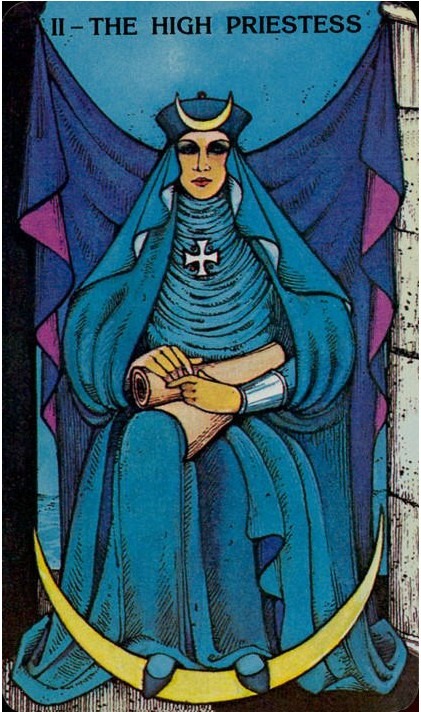
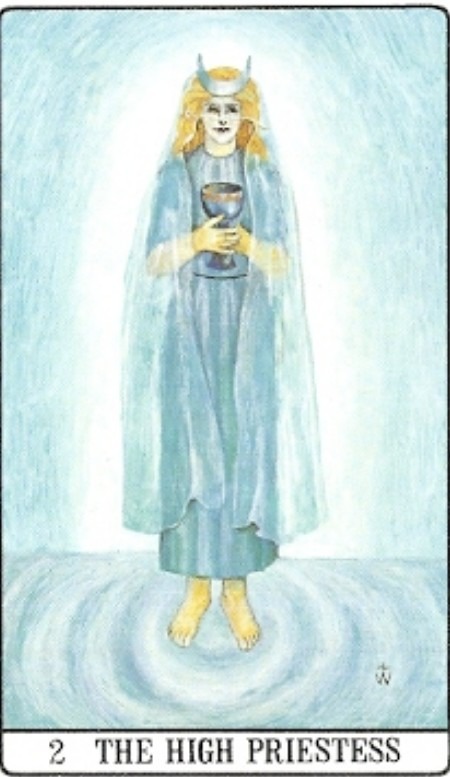
Her crown might represent a sun between two horns, or it could show a full moon with a waxing and a waning crescent on each side. Some say it represents the crown of Isis, while the crescent moons link her to the sky goddess Hathor.
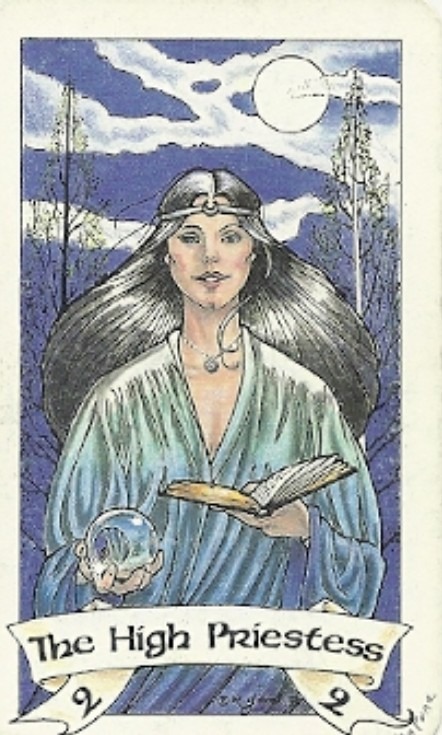
Many contemporary designs show her with a crescent moon at her feet. Across cultures, it was a god who had responsibility for leading or dragging the sun across the sky each day, while it was goddesses like Luna, Selene or Hecate, thought to be responsible for the moon’s triple faces and monthly cycles.
The moon controls the tides and the element of water has long been associated with female experience. It represents the subconscious mind, home to emotions and the source of intuition.
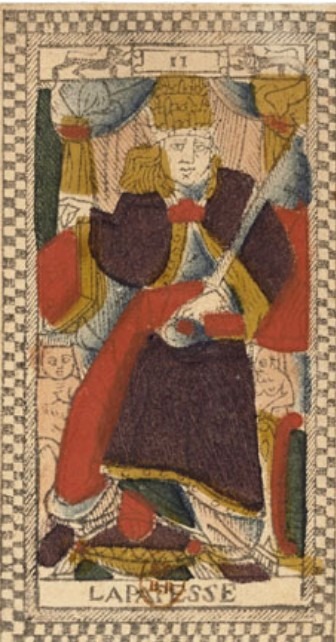
The high priestess sits between black and white Pillars. The letters ‘B’ and ‘J’ stand for Boaz and Jachin, the names of the pillars at the entrance to Solomon’s Temple, a king associated with knowledge and wisdom.
The pillars represent the polar opposites of darkness and light. Positive and negative. The yin and yang of eastern philosophy, and the principles of masculine and feminine. Together they symbolise balance. The high priestess is showing out fool how reality is full of dualities or opposites.
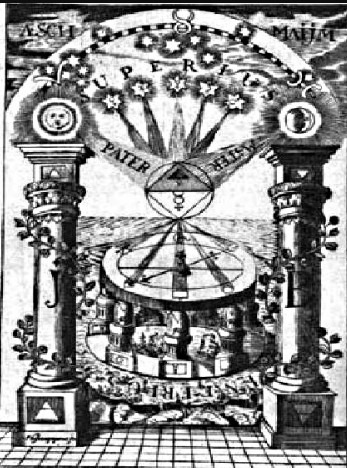
Behind the high priestess a veil is strung between both pillars, there’s a glimpse of water but nothing more. She is guarding the inner mysteries within the temple
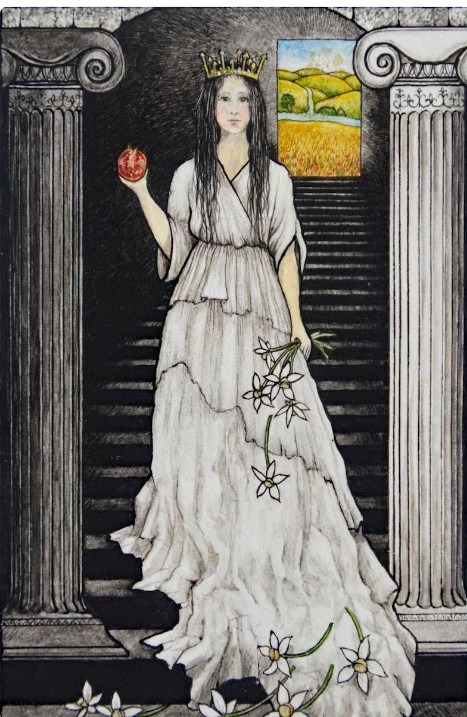
The veil is covered with pomegranates – long connected to beauty, mystery, and the feminine.
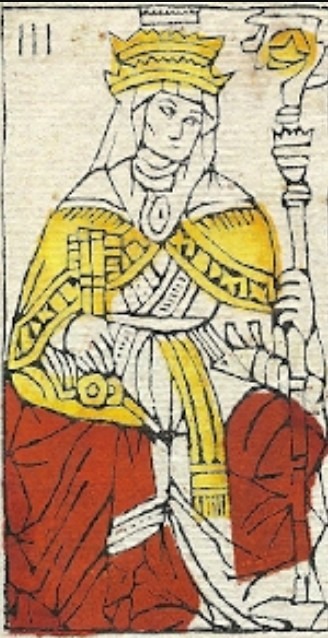
The cross on her robe has arms of equal length. Some see it as a plus sign suggesting her position between the two pillars is a symbol of unity.
The traditional crucifix is a symbol for Christianity, but the arms of this cross are equal in length. As well as being called a solar cross, it might also signify the four tools or elements we saw on the magicians table; the cup, sword, wand and pentacle.
The book she’s holds is titled TORA, which might be with or without the H of TORAH. The TORAH contains the first five books of the Hebrew Bible, known in Christianity as the Pentateuch. The word torah derives from the jewish to teach or to guide so regardless of the detail, she is holding a book of knowledge.
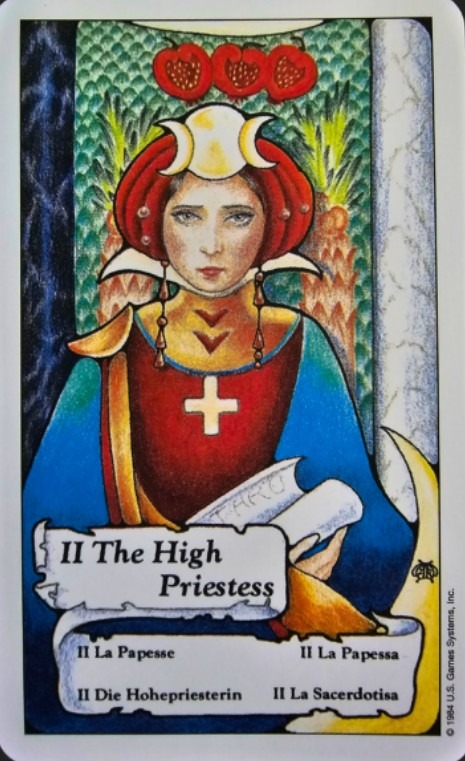
The high priestess is all about the merging of the conscious and unconscious self, so lets take a look at the messages she might have for the fool.
Her knowledge is all encompassing but her world is one of symbols and shadows. We’ve moved beyond words. She is all that is felt rather than spoken, so there are no direct statements, only the whisper of intuition, that small quiet voice inside.
The high priestess operates through instinct, and meaningful synchronicity.
She has the skills of prophecy, and divination but it’s too soon to explain all this to the fool – he needs to focus on this stage of his journey, to bring into conscious awareness all those feelings he’s hidden or repressed and has chosen to ignore
The fool needs to create space for silence and stillness. It will feel strange, maybe even uncomfortable but is a necessary step on his journey.
Rather than acting on impulse, he must learn to pause, analyse his response and listen to his intuitive voice for guidance.
And because the high priestess is connected to the moon which controls the tides, the fool needs to learn about ebb and flow. Life is full of ups and downs, high and lows. This is the way of things . The good times will pass but so will darker more anxious ones. Once the fool realises life is full of these rhythmic cycles, he’ll be better able to cope with them.
We’re taught to see opposites as differences but duality is an illusion. Oppsotes are equal parts of the same whole . There can’t be one side without the other.
The high priestess can signify a refusal to face yourself, to step aside from the external material world and explore the inner one. She might suggest emotional imbalance or the inability to listen.
Women have long been culturally portrayed as passive, but have also been called irrational, devious or cunning. The high priestess can signify these darker sides.
The magician represented the hermetic principle of as above so below, the High Priestess is the following line which says as without so within.
She’s a bridge between the material world of the magician and the non-material world of the temple. The power of the magician was directed outwards to effect change in the conscious world. The high priestess turns the light of the moon inside to discover what can’t be seen on the surface.
The fool needs to harness the powers of focus and manifestation he learned from the magician but to direct them inwards. Only then can he begin to explore what lies in his unconscious and subconscious layers.
However, now is not the time for all the answers.
They’ll come later as the fool travels through the cards.
For now it’s enough to know the high priestess sits in front of the temple which is veiled. There’s a glimpse of water, which has long been used to represent the unconscious mind, but we’re not being invited in – not yet.
There are five more cards to meet on the first line and the fool is still operating from his conscious self.
At first, he might dismiss the high priestess.
She’s all about stillness and silence whereas he wants to move on, especially after encountering the creative energy of the magician
or
her cool calm exterior might intrigue him. Something inside may respond, even though she hasn’t yet spoken.
Like the other cards, the high priestess is there to show him what he needs to know, even if he doesn’t yet feel ready, and she will always be there, waiting for him to return
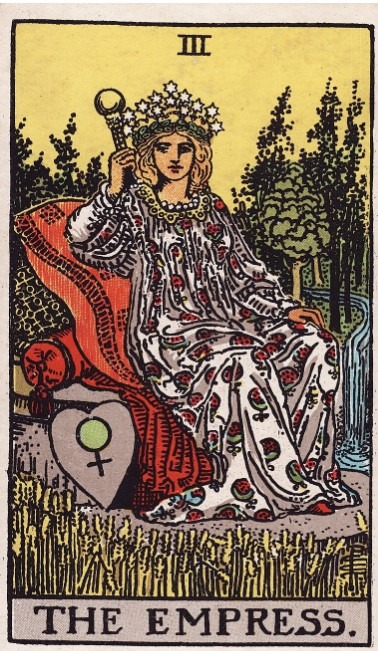
The next card in a walk through the tarot, is number 3, the empress.
She is the energy of the magician made manifest through nature.
An earth mother goddess archetype, the empress represents magic and mystery of a different kind, so join us as we take the next step on the journey…
images my own, copyright free from wikipedia commons or from https://pixabay.com/