The fool has survived the darkness of his subconscious fears and demons in the moon card. On the bare lunar landscape there was no place to hide but now he’s returned to world of conscious thought and action.
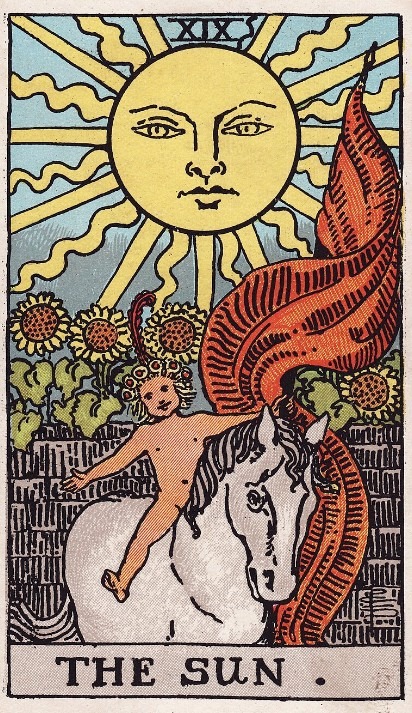
This is card 19, the sun.
The fool is walking towards the end of his journey. This line has been hard and he’s content to sit awhile. To absorb the sun’s light and energy.

The sun is the last of the three celestial cards on the third line.
The fool has felt a magical sense of integration with the star and faced the depths of his subconscious on the moon. Now he feels the power of the sun, 93 million miles away yet its heat can kill.
The fool is reminded of the empress and her cycles of fertility and growth. He thinks of the emperor and the arid rocky landscape of his world, where nothing grew except the twin poles of ambition and failure.
Human life depends on the sun, a giant ball of gas and fire which maintains precisely the right distance from the planet and is larger and hotter than the fool can ever imagine.

In the 15th century world of renaissance Italy, with religious scriptures full of references to light, it would be a surprise if early tarot images did not contain the sun in one form or another.
All ancient civilisations had sun gods.
In Mesopotamia there was Shamash and Uru.
The Egyptians had Ra, who later combined with Amun to become Amun-Ra.
The Greeks and Romans both had Apollo who was depicted with crown or halo of light. Despite the dominance of the church, because the scriptures related Jesus to the light of the sun, pagan images of Apollo were generally accepted as valid.

In the year 380 AD, the Edict of Thessalonica made christianity the sole religion of the roman empire but multiple christian sects and mystery schools existed at the time, all of which were officially disallowed from that point on.
One of these was Gnosticism, named from the greek gnosis for knowledge.
The Gnostics believed all individuals had a spark of god or the divine within them. They taught the purpose of life was to turn away from the external material world to discover the divinity within.

The Gnostic gospels, also known as the Nag Hammadi library, were rejected but make interesting reading, in particular for the experiences of disciples such as Philip, Thomas, James and Judas, as well as the mysterious gospel of Mary.
The experience of divinity, as understood by the Gnostics, is not so different from a search for psychological wholeness in the 21st century, or the purpose of the fool’s walk through the tarot.
They all deal with similar issues around how to live a better life.

The Visconti Sforza tarot from the late 1400’s shows a cherup holding the sun which wore a face which might be Apollo but other decks from this time portray different stories.
The 15th century d’Este tarot shows a bearded man sitting inside a cave. The image is thought to represent Diogenes who lived the life of a hermit with no material possessions, and was content to live under the light of the sun.
The Budapest tarot, also from the 15th century, shows a shining sun above trees, suggesting the flourishing power of nature.

Another deck from this period is the Charles VI tarot. Here the sun card shows a woman holding a distaff and spindle set against a golden brocade background.
To spin required daylight and spindles also appeared in early versions of the moon card. They represented women’s work, regardless of social status, with the circular motion of a spindle being like the moon and sun’s daily cycle across the heavens.

It was a popular depiction for this card, appearing again in the Rothschild tarot from c1500 and the Vandenborre and Della Torre tarots from the 17th century.

In 1650, the Tarot de Paris or Parisian tarot shows another different design.
Here a woman is gazing into a mirror held by a monkey.
Monkeys were popular pets at this time, especially in wealthier families, so this image suggests wealth as well as vanity although its direct connection with the sun remains more obscure.

Today the sun card commonly shows a horse with a child.
The first deck to include the image of a horse and rider was the Jacques Vievil tarot which shows a naked person carrying a banner.

In the Vandenborre tarot the rider is naked but wears a red sash and his banner has a red cross, similar to the insignia of the Knights Templar.
Sacred art often showed Jesus carrying a flag with a red cross on a white background which represented triumph over death.
The de Hautot tarot from the early 18th century has a rider dressed in armour.
These cards all have the drops of rain or blood which were seen on the moon card.

The Marseilles-style decks substituted a single rider for two partially naked children in front of a wall.
This led to suggestions the boys were in an enclosed space or garden which represented a safe place with the boys being linked to the Greek myth of the brothers Caster and Pollux.

The French occultists retained the image of two children.
For Oswald Wirth, they were positive and negative binaries, or a symbol of the mortal body and immortal soul.
The world of the sun was physical but in esoteric texts, material can have access to the non-material.
The spirit or soul is embodied but can be reached through the acquisition of occult knowledge and experience.

The sun card in the Golden Dawn and the Magical Golden Dawn decks show a boy and a girl.
The boy stands on the land and the girl is standing in water representing the duality seen in temperance and the star.

The Waite/Coleman Smith design shows a naked boy riding a pale horse similar to the one ridden by death and maybe an analogy between life and death.
He carries a disproportionately large red banner while behind him sunflowers grow from the top of a brick wall.
In his Key to the Tarot Waite says the card signifies the light of both material and non-material worlds. The light also represents the self knowing spirit emerging within the conscious self. The walled garden symbolised the unconscious while the sun was consciousness in the spirit.
For Waite, the child stood for restoration.
An opportunity for a fresh beginning.

The fool has come along way.
It seems a long time since he met the magician and high priestess at the start of his journey and he’s absorbed the lessons from the archetypes in lines two and three.
Now he can re-interpret the events of his life.
Pick apart the patterns of social conditioning.
In doing so, the fool can see much of what he believed was a cultural construction rather than being real or innate.

During the fool’s walk through his subconscious self on line three, he’s faced the entrapment of the devil, destruction of the tower, freedom of the star and surface horrors of the moon. All these experiences have now been transformed into the joy of living as portrayed by the sun.
The fool has completed the rituals of initiation.
Become enlightened.
He’s faced his worse fears and survived.
Here is the inner sense of wholeness he experienced with the star.

He’s taken down the walls of his unconscious and subconscious self, faced his repressed experiences and emotions, and has now returned to the physical world.
He feels complete and whole.
The inner and outer parts of himself have integrated.
Much of what the fool previously believed has been shown to be illusionary.

His fears were less rooted in reality, and more a result of his own interpretations.
The fool can’t be blamed for having a surface view of the world around him. It takes courage to go against widely accepted views and requires time and effort to dig deeper.
Up until now, he’s never had the opportunity.
It’s a good day, one of his best.
He’s emerged from the dark into daylight.

From now on, he’ll remember this feeling of triumph and validation.
When times get tough, which they will, the fool has learned to cope. No matter how bad it gets when the wheel of fortune dips down, he’s acquired the knowledge and experience to get through.
The sun represents this outcome.
The sources of negativity within have been released, and with this comes a sense of lightness.
He can see how his responses to life circumstances have felt real but were frequently instinctive. Without wider knowledge, events and reactions can be automatic, in particularly when situations not fully understood at the time.

Dysfunctional childhoods, or the outcomes of poor choices, are often beyond intrinsic control but the fool has learned he has potential to change their effect on him.
This power has created an inner sense of unity.
He sees how everything in the world is connected and related, united through universal energy. Not only is he experiencing a sense of integration within himself, he is also more at one with the wider universe.
The sun is the freedom we feel once the chains of the subconscious have been released and broken, restoring us to wholeness.

Today, in the light and warmth of the sun, his walk through the tarot feels complete, but there are still two more cards to meet.
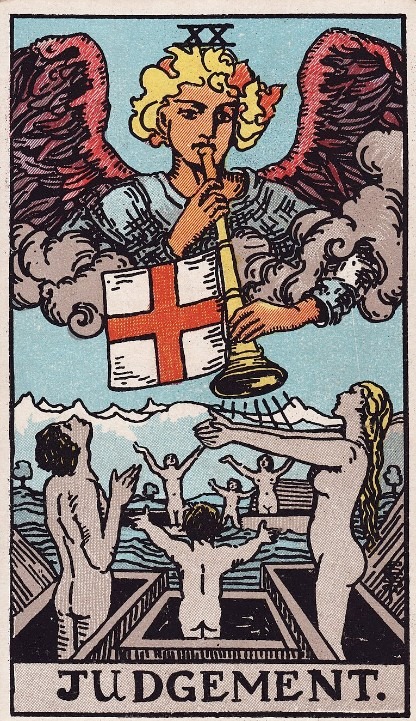
The next card is judgement where the fool will find a third angel. The first appeared in the lovers and the second in temperance. The angel of judgement presides over a series of open coffins, with bodies rising in response to the angel’s call.
What is there left for him to learn?
Join the fool as he meets the penultimate card.
images my own, or copyright free from wikipedia commons and https://pixabay.com/