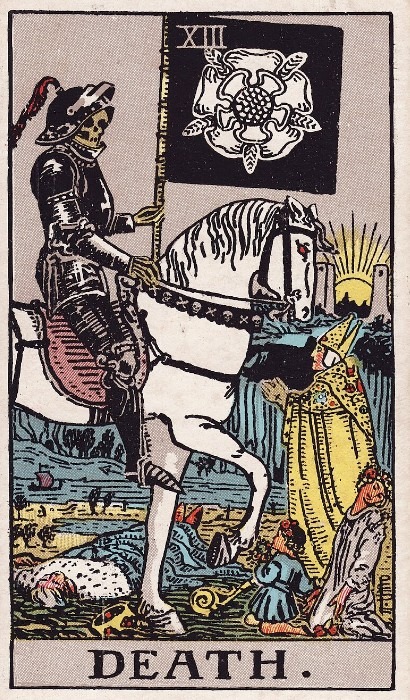
After the mysterious hanged man, the fool has arrived at card 13, the traditional number of bad luck or misfortune. He’s looking directly at an image of death.
He steps back, unable to stop the rush of fear.
In the Waite/Coleman Smith deck, a skeletal death rides a beautiful horse, maybe a palamino, and carries a black flag emblazoned with a white rose, a symbol of purity and new beginnings. Yes, there’s people, both dead and alive, but in the distance are white pillars with a morning sun rising between them.
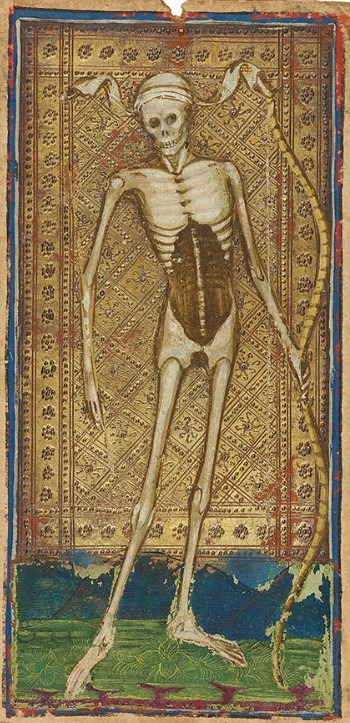
Like most children, the fool has been brought up to see certain things in definitive ways. Death was the hush-hush subject no one wanted to talk about, but he’s learned the cards don’t always represent their surface appearance.
Despite its name, this card also seems to be about life.
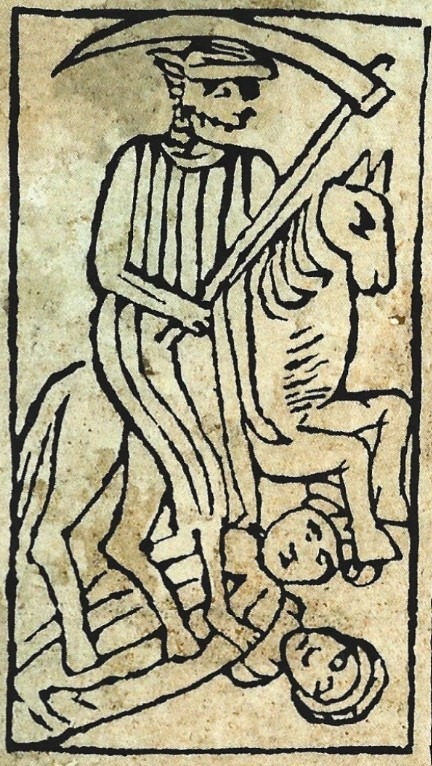
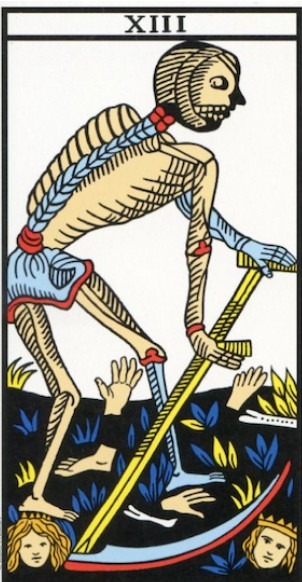
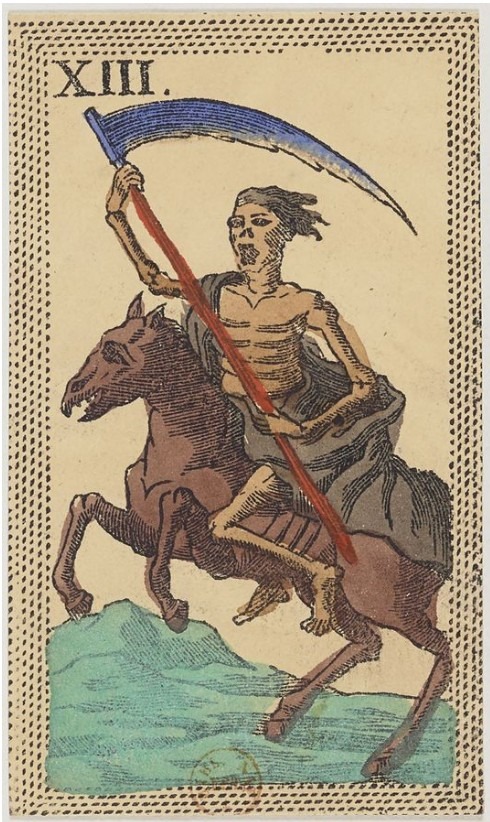
In the earliest tarots death was portrayed with all the realism of disease and its horror.
In 1347 the Black Death or Bubonic Plague had swept across Europe, killing over half the population. Medical knowledge was basic, accidents common, and childbirth often fatal.
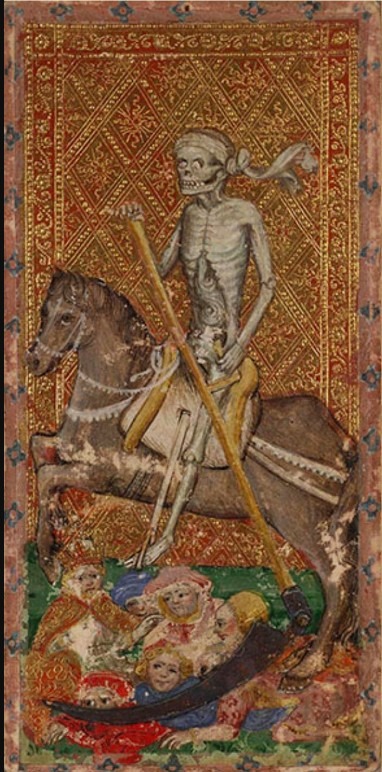
The fool knows Christianity has a lot to say about death. Sometimes he’d thought that was the purpose of all religions – to provide answers to the unknown.
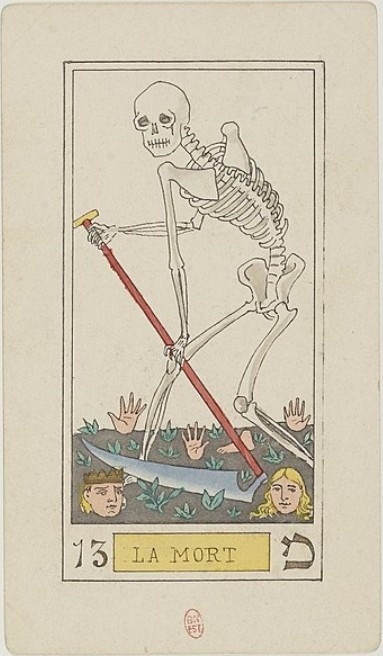
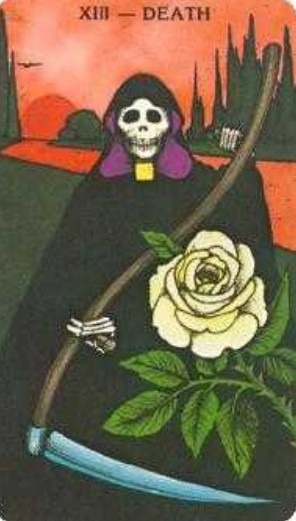
The macabre, or dance of death, was also a popular subject in art, both religious and secular, and early tarots often showed death as the grim reaper, harvesting people by cutting them down with a scythe.
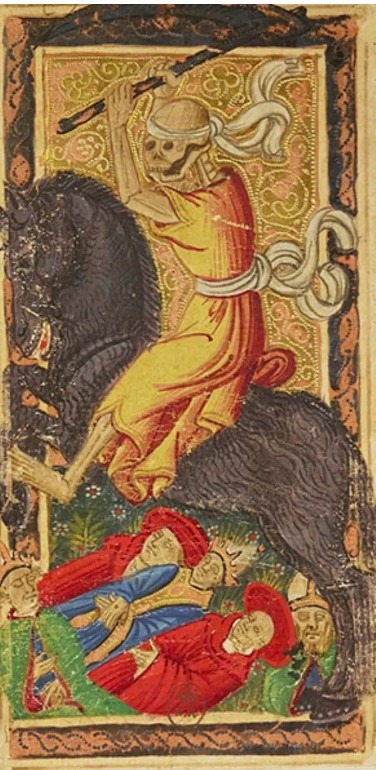
The bible’s book of revelation includes the Four Horsemen of the Apocalypse who represented conquest, war, famine and death.
I looked, and there before me was a pale horse! Its rider was named Death, and Hades was following close behind him. They were given power over a fourth of the earth to kill by sword, famine and plague, and by the wild beasts of the earth. (NIV, 6:8)
Death has also been personified as an angel, responsible for taking care of the souls of the newly deceased.
In Greek mythology, Hermes guided the dead to meet Hades. the god of death. The angel has had many names including Azrael, Samael, Sariel, Malak al-Maut and Anubis.
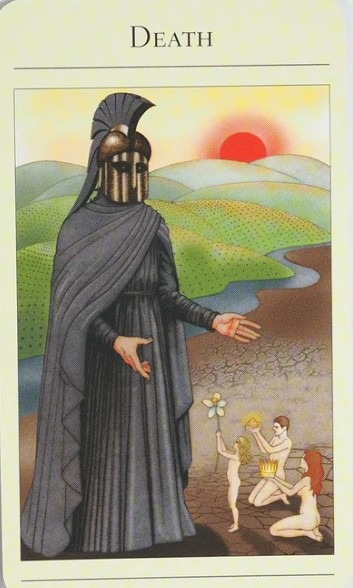
The cultural transformation of death from marking the end of life to becoming more about transformation is reflected in tarot images across the centuries.
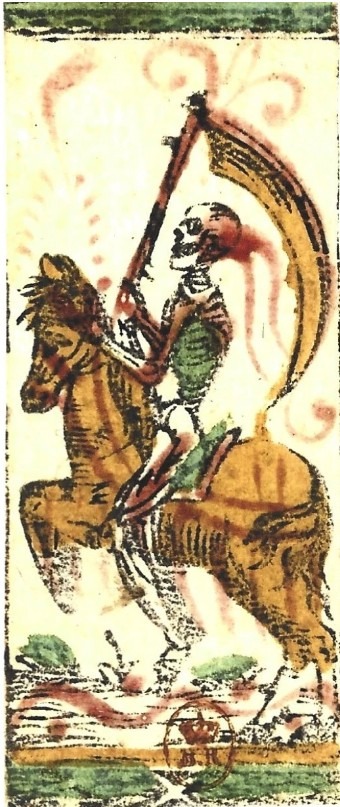
During the Renaissance claims of seeing ghosts became demonised while the growing body of medical knowledge pushed previous ideas about death into the realms of superstition and folklore.
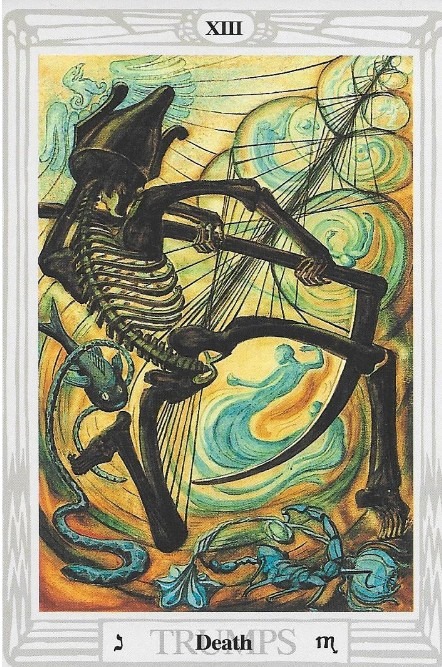
The adoption of tarot by the French occultists, led by Etteilla, promoted death as a more generic ending for projects or ideas. It could also represent corruption or destruction.
Occultists Eliphas Levi and Oswald Wirth focused on the theme of transformation, claiming people did not return from death but their actions in life would continue.
Endings were as much a part of life as the ending itself.
The Waite/Coleman Smith tarot incorporates many previous images. as well introducing ideas from the Rosicrucians, Freemasons and Christian mysticism.
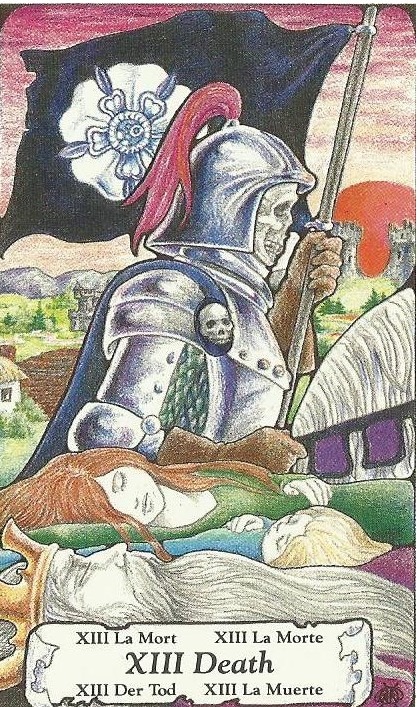
The fool sees a skeleton dressed in black armour. The horse steps over a king lying prostrate, possibly dead. Kings, like the emperor, operated in the physical world but are separated from their subjects or citizens by immense wealth and privilege.
In the world symbolised by the death card, those with dominant egos, accustomed to the trappings of power and gold, cannot survive. Earthly rulers might live their lives protected from harsh realities but death still comes, eventually.
A bishop has lost his ceremonial staff or crozier. He holds out his hands, pleading or beseeching. Like the hierophant, he is partially protected by doctrines that deal with mysteries so may be begging for mercy or disputing death’s authority.
A young boy and a girl are on their knees. The girl looks away, seeming to ignore what’s happening in front of her.
Maybe she simply can’t believe the world she knows is falling apart, and is unwilling to surrender to the truth that everything comes to an end.
The little boy stares directly at death, whose black flag bears a white rose, the symbol of purity and new beginnings. He seems younger than the girl and looks curious.
He might be more able to accept change because he doesn’t yet have the knowledge of how it might impact on him.
In the background, a boat sails on the river. It could be a direct reference to mythological rivers of the dead like the underworld Styx or simply represent movement.
Water is in a continual state of transition.
Puddles dry up or rivers become seas.
Greek philosopher Heraclitus said, you cannot step into the same river twice and this constant state of change lies at the core of life. It’s a lesson the fool has met often since the magician at the start of his journey.
In the tarot, the death card symbolises transition and change
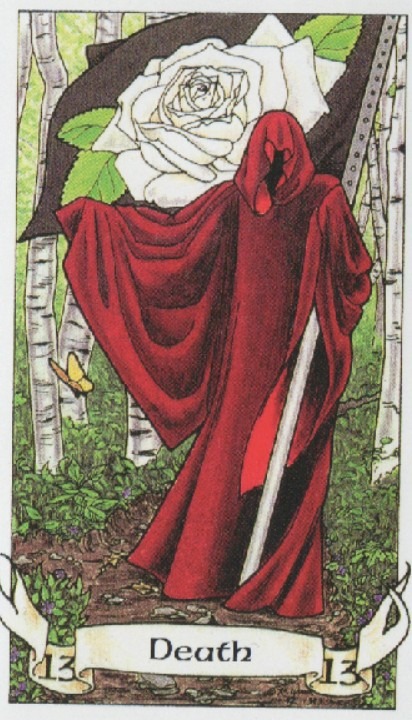
The fool had carried a white rose when he set out on his journey, when his life was firmly fixed in the physical world of consciousness. The rose represents beginnings which start clean and pure because they’re new. The fool hasn’t yet begun to incorporate or put his mark on them.
Now he’s face-to-face with the white rose of death.
The fool needs to swallow his fear, take a deep breath and be ready to watch and listen. He’s being asked to step into the unknown, to see himself in a different light.
Death represents the next stage of the fool’s own transformation.
It marks the disintegration of his old self and readjustment to the person he can become. This death is metaphorical and an essential step on the journey.
It won’t be easy.
Familiarity can represent security and comfort so letting go can be a difficult process.
Death is the space between closing an old door closing and the opening of a new one. It takes the fool back to the first card, the magician, who spoke about action. The first step sets intentions in motion.
If we open the door, the universe will respond with opportunities to increase knowledge and understanding. The fool has touched on this with the hermit who represented solitude for learning and reflection while the hanged man was acceptance of change and a taste of surrender.
It’s time for the fool to accept he’s no longer the person he was when the walk through the tarot began. He can let fear take control and stop – or he can prepare himself for a different kind of future.
All the cards he’s met so far have been leading to this choice.
The fool is being asked to abandon the old ways he used to get by.
Let go of beliefs which no longer serve him.
Put the ego part of his conscious personality to one side.
Ego has been the dominant driver of the fool’s life. It’s the lens through which he’s seen and interpreted the world but death signifies the end. It’s time for the outer mask and identities to be laid aside so the unconscious self can rise to the surface.
The fool is afraid.
He wants to hold on to the familiar but death is telling him the old must be given up before anything new can fill the space and he’s worried there’s no guarantee. What if this is all a lie or fantasy and there’s nothing else left for him?
At first, the idea of meeting universal archetypes had felt strange. The fool hasn’t understood everything he’s been told but has a better awareness of who he is and accepted much of what he’s learned.
After all, there’s been many unarguable truths. They’ve given him answers to questions in ways he never came across at home.
The fool has come a long way but now feels he’s in a void.
It’s like the cliff edge again, the point where his journey began.
He has to take the next step to in order to progress, but without guarantees he’s uncertain.
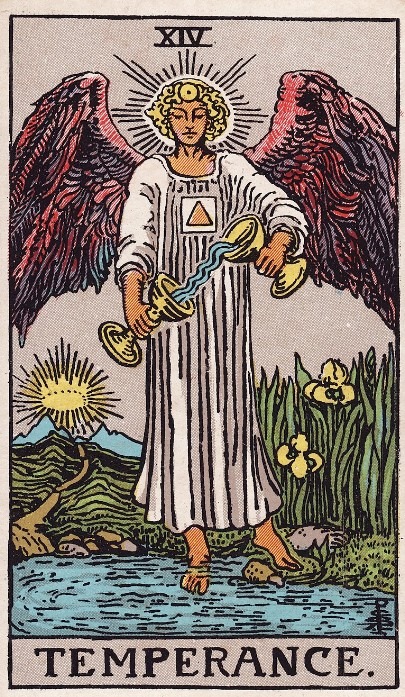
The fool is nearly at the end of line 2 which has been introducing his unconscious self. The next card is temperance. It will be a relief but he doesn’t know that yet.
Join us for the next step on this walk through the tarot, where the fool will come face-to-face with the angel of temperance and see with his own eyes what can happen if the invitation from death is followed.
images my own, or copyright free from wikipedia commons and https://pixabay.com/