
The fool has arrived at card 4 the emperor. He was reluctant to leave the empress. She’d appeared friendly and the fool felt content to stay. Take in all she had to show him. Approachable, almost familiar, there was a sense of motherliness which reminded him of home.
Her counterpart, the emperor, is very different. A figurehead for state legislature and authority, he lives within a system of rules and regulations, many of which he will have made or altered for himself.
Little about this card suggests welcome.
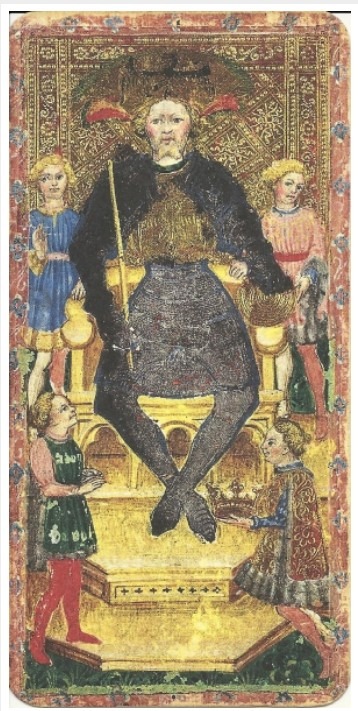
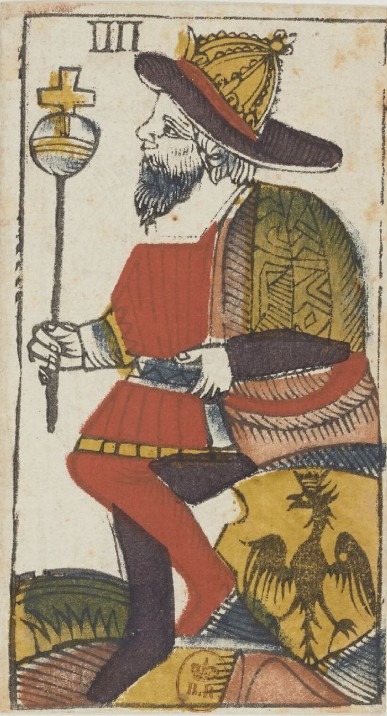
The oldest tarot decks appeared in 15th century Europe. The continent was divided into empires and kingdoms with an king or emperor having supreme power and control. Tarot shows kings in the suits of the minor arcana, and symbols of royalty appear in some major arcana images, such as death.
The fool has met the empress and is now standing in front of her partner, the emperor.

All lushness has vanished. The world of the emperor is arid and rocky. Nothing grows. Dominant colours are red and rust.
Here’s a man accustomed to domination and control, his strength and determination coming from age and experience. He has economic and political power alongside the social and cultural privilege that comes with being at the top of the food chain. Everything about this card represents the world of materialism and physicality.
The fool feels nervous.
Early tarots show the dominant players from all social strata. The previous post explored the shift from the empress as official co-head of state to more earth mother goddess but the emperor has remained much the same as when he was first portrayed. He deals with power in the material rather than any mystical world.
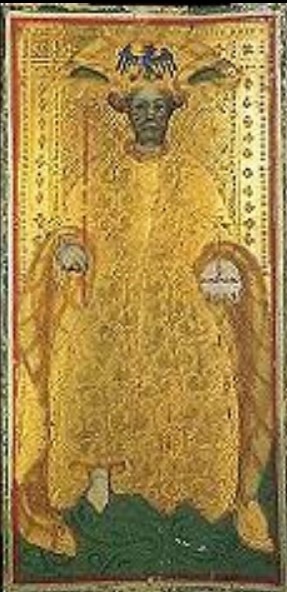
What you see is what you get.
The 18th century shift to more occult interpretations of tarot claimed the emperor was not only an earthly leader, the card has evolved to represent the divine masculine or cosmic fatherhood.
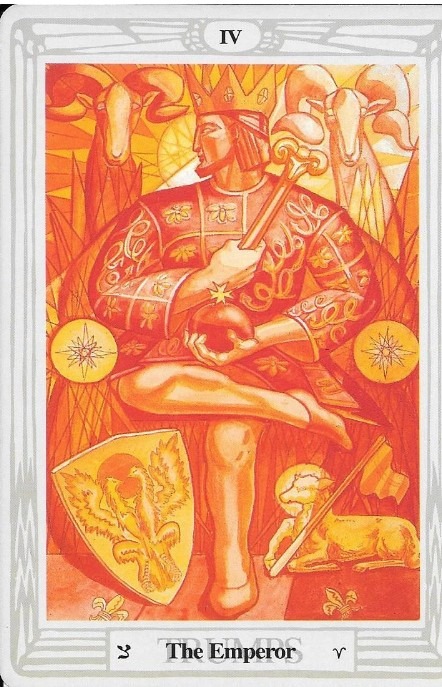
Occultists introduced elements of astrology and numerology. The emperor was associated with the zodiac sign of Aries which embodies leadership, determination and directness.
Aires planet is Mars, long thought of as the god of war while the number 4 can signify the elements and cardinal directions.

In the kaballah, 4 is heh for window or gateway to spiritual understanding.
Representing the breath of life or divine presence (Shekhinah), which is in all living things, heh is the first Hebrew letter of the name of god.
Royality and divinity are connected and the emperor also held the title of Holy Roman Emperor with responsibilities to defend Roman Catholicism. The occultists expanded on this to incorporate a more esoteric approach to religious belief.
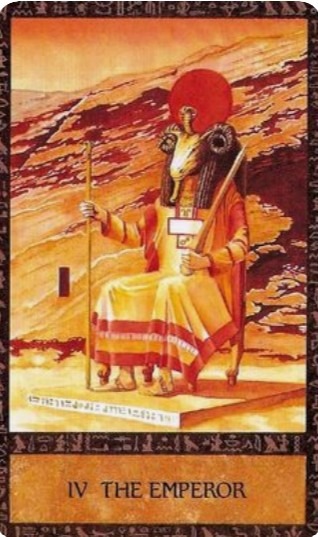
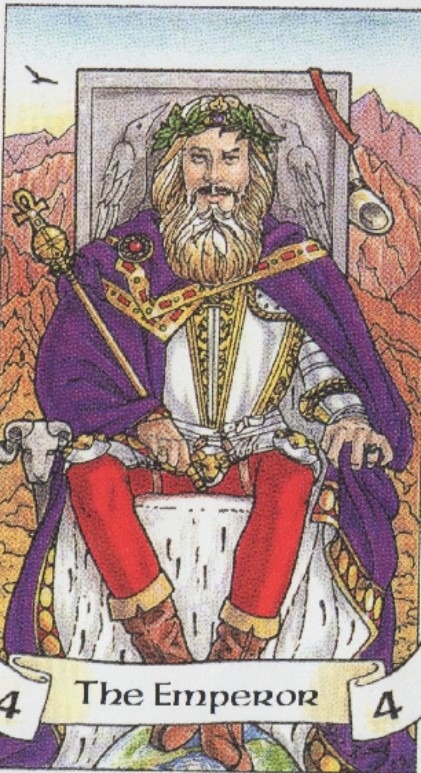
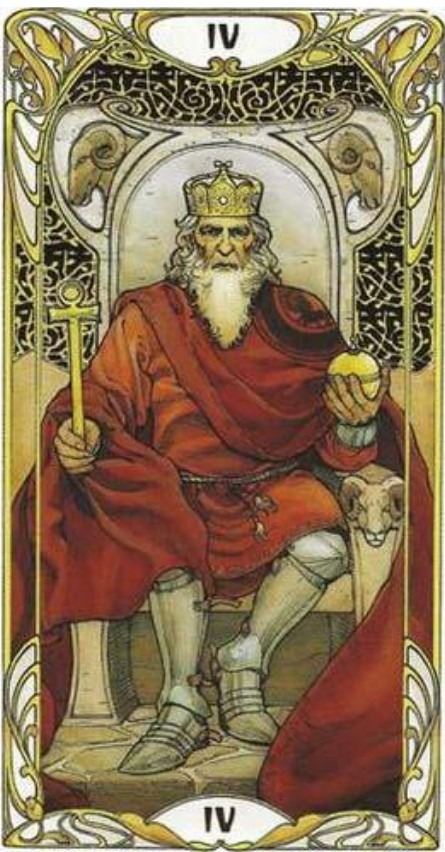
The Waite/Coleman Smith emperor included symbolism rooted in ancient Egypt. The back and arms of the throne in this deck are decorated with ram skulls, traditional symbols of strength, and associated with rulership. Thousands of mummified ram skulls have been found in a temple for Ramses II, while the Avenue of Sphinxes at Karnak is also known as Rams Road.
In his Pictorial Key to the Tarot, Waite calls the emperor a Lordship of Thought as opposed to his throne which is a symbol for the intellect.
The embodiment of willpower, the emperor can be seen as a father figure, as the empress is motherly, but in any relationship it’s the emperor who will have ultimate power and control.

Regulation and rationale are his things. With all the trappings of authority, there’s no avoiding the emperor’s connection with competition, conflict and combat.
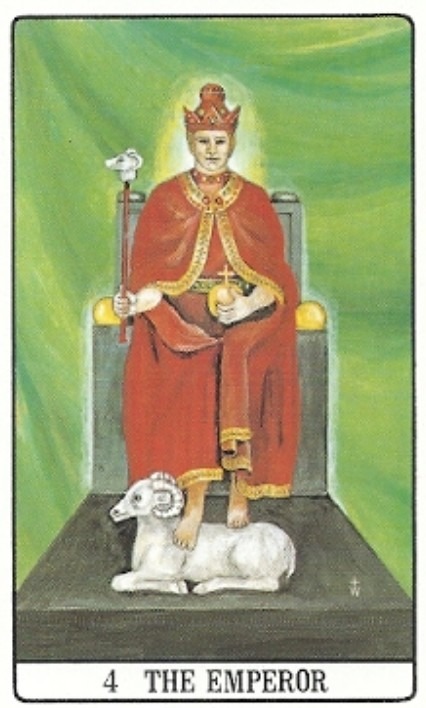
In his left hand, there’s an orb or globe with a sceptre or crux ansata in the right. The latter is topped with a loop, similar to the egyptian ankh, and associated with immortality.
The stone throne is imposing, almost disproportionate in size. Set on a large dias to signify his elevation, the throne looks hard and unflexible. There’s little indication of comfort. The throne is almost as intimidating as the emperor himself.
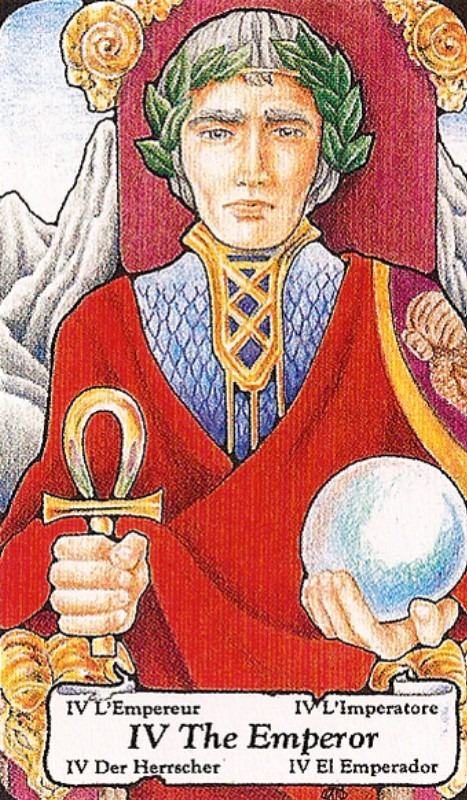
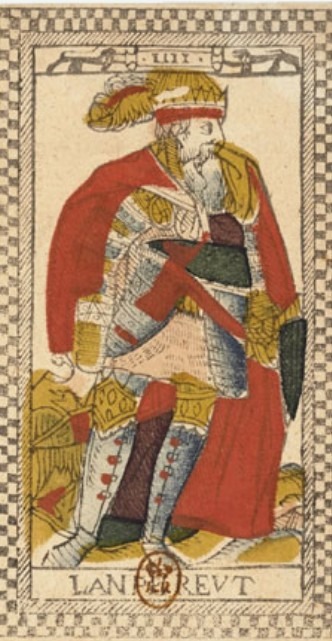
The earliest tarot emperor’s don’t wear a crown. This appears later and is usually made of gold, encrusted with gems. The majority of images show a closed rather than open-topped crown, and some say this indicates the wearer is shut off from higher energy forces.
The emperor himself has maturity, with long white hair and beard. His robes are purple and red, the colours of royalty, reserved for emperors and kings.
Beneath his clothes he wears full armour. The emperor has experience of war and is familiar with how conflict can be necessary to achieve and retain his status. Armour also suggests a constant need to be prepared for further attack.
He can never rest or relax his guard.
The emperor is everything the empress is not.
By name they are paired, like the magician and the high priestess, but these two could not be more different in their personalities and symbolism.

While the empress represents the force of nature, the emperor has control over society. They are a balance of opposites which together create a whole. As the fool continues his walk through the tarot, he’ll begin to see relationships forming between the cards.
The emperor is austere, rigid, and controlled. A patriarch with knowledge and experience. Epitome of the masculine psyche, he can be a soldier, leader, warrior, king, and maybe sometimes even a hero. These are all examples of the emperor archetype.
There’s no gentleness in this card. The emperor is an immovable force with total control over his will. This is a different energy to the creativity of the magician, while the subconscious world of the high priestess is absent
He’s the wall you can’t get through.
A locked door that won’t open.
The fool can’t decide if the emperor is looking at him or past him but either way, he senses his imperviousness.
What lessons does the emperor have to give?
It’s the first time the fool has met someone with such social status and secular power.
Nothing comes from nothing. The emperor is showing the results of achievement through hard work and effort, yet the bare landscape suggests a loss of connection with the natural world of the empress which represented fertility and regrowth.
The fool is being shown the risks of imbalance. Success can be achieved but at what cost?
If the price is too high there’s a risk that achieving goals will create a disconnecttion from universal love and humanity.

Remote and severe, any obvious resemblance to a loving father figure is well disguised.
The fool feels no paternal connection, but he’s aware of admiration for all the emperor appears to have achieved.
The fool senses accomplishment and success personified, but like the archetypes he’s already met – the magician, high priestess and empress – the emperor card contains binary interpretations.
This is the end result of a life spent dealing with the maintentance of authority. What lies behind the emperor’s success is hidden, but if the fool has been paying attention and listening, especially to the magician, he will know all actions have consequences.
Progression and success come directly from personal effort and leadership requires both determination and resilience.
If the fool wants to achieve any sense of authority on a temporal level, he must be prepared to make sacrifices and maintain consistent motivation. Difficult decisions will need to be made, alongside learning to manage a range of different people and situations.
What seems to be missing from this card is passion or spontaneity. There’s an absence of joy and laughter. The emperor risks becoming unemotional and repressed, forgetting what it means to be human in terms of care and compassion.
He shows the fool a balance needs to be found between benevolence and tyranny. Laws should aim to create safe environments rather than underlie persecution and constructed inequalities. Strict adherence to rules and their enforcement can cause harm rather than support fairness and truth.
The sterility of the emperor’s landscape should not be reflected in the fool’s heart and soul because that will prevent the development of meaningful relationships and connections.
The next archetype the fool will meet is the hierophant. This is an interesting card. At first glance it appears overtly religious and may feel outdated for many, but the fool wil learn how it can be understood on multiple secular layers.
Join me as we take the next step on a walk through the tarot.

images my own, copyright free from wikipedia commons or from https://pixabay.com/