
Fresh from his time with the hermit, the fool is puzzled by card 10, the wheel of fortune. It’s the most mystical card he’s encountered so far and he isn’t sure what to make of it.
Familiar with the concepts of change, lucky streaks and plain misfortune, especially when things happen outside his control, the fool knows these are often represented as a turning wheel, but the symbols on the card appear confusing.

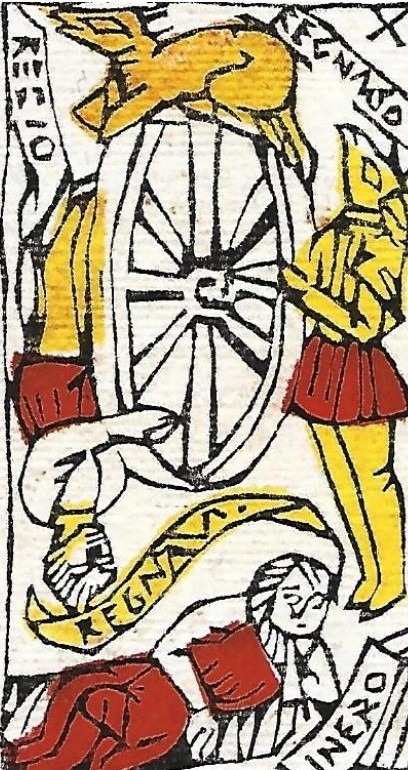
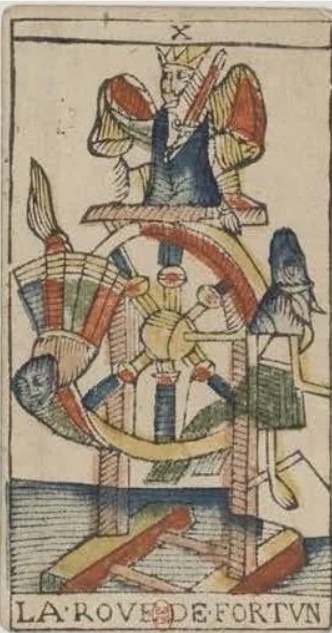
The card has remained more or less constant in design since the earliest tarots, such as those commissioned by the Visconti and Sforza families in 15th century Italy.
The wheel represents Rota Fortunae, the wheel of Roman goddess Fortuna, derived from the Greek goddess Tyche or luck. Both were responsible for fate or destiny.
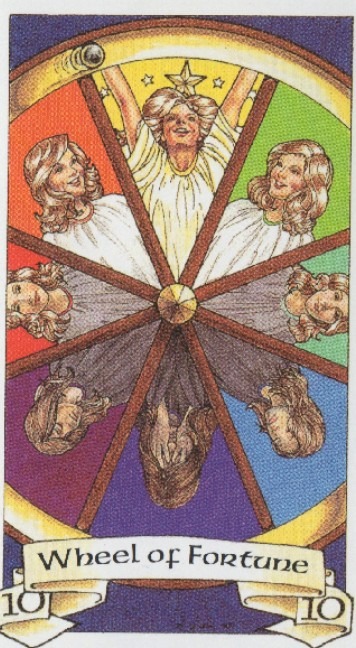
Nearly all historical versions show a wheel, with a variety of different figures attached.
All of the cards represent the turning wheel of life.
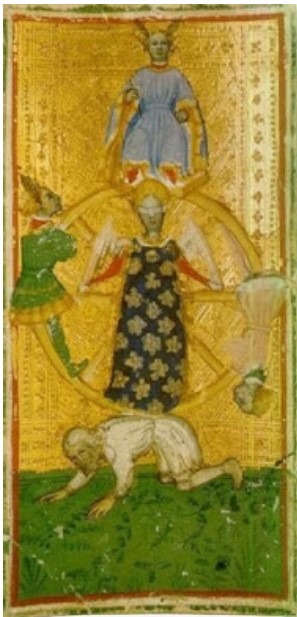
The idea of fate derives from the ancient greek sisters Clotho, Lachesis, and Atropos. Together they were the Moirai (Roman Parcae) who created the threads of each individual life. Clotho spun the thread, Lachesis allotted the thread’s length, while Atropos decided the point at which the thread was cut and life ended.
Fate was fickle.
Unpredictable.
Beyond control.
Destiny however, was slightly different. Whereas fate was uncontrollable, destiny suggested each life had a predetermined pattern set at birth.

The concept of the wheel of fortune was popularised through literature such as the 6th century work by Boethius called The Consolation of Philosophy and The Ship of Fools by Sebastian Brant in 1494.
The wheel of fortune often showed animals as well as humans
From the 16th century many tarots showed animals such as donkeys, monkeys and rabbits travelling around the circular wheel. These represented acceptance of the present moment, believing it to be all there was.
Where human figures appeared they often resembled rulers, situated at the top of the wheel and appearing to be in control, while others showed a person falling and travelling downwards.
The wheel of fortune constantly turns and those attached to it will both rise and fall, either throughout their time or through the eternal cycle of life and death
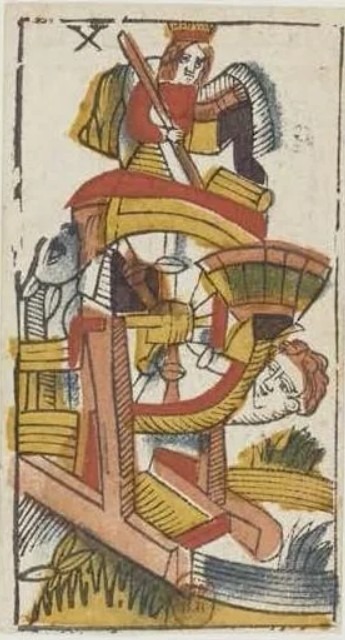
As with the previous cards, the adoption of tarot by the French occultists in the 18th century, led to changes.
Eliphas Levi incorporated the Kabballah and ancient Egyptian myth, alongside the concept of the wheel seen in a vision by the Jewish prophet Ezekial. In the book of Ezekial (1:1–3:27)
The prophet is visited by god who rides a chariot. It has wheels within wheels known as Ophanim, and is drawn by winged creatures with four faces, a man, lion, ox, and eagle who, in the bible’s book of Revelation, became the disciples Matthew, Mark, Luke, and John.

On the right of Levi’s image was a Hermanubis, a combination of the ancient Egyptian god Anubis and ancient Greek god Hermes, both with responsibility for the souls of the dead.
On the left Typhon, who was defeated by Zeus in the the Titanomachy, a war beween the Titans and the Olympians, was descending.
Above the wheel was a figure of the sphinx. It wore an Egyptian headdress and had wings. This figure represented the figures accompanying the wheel in Ezekial’s vision.
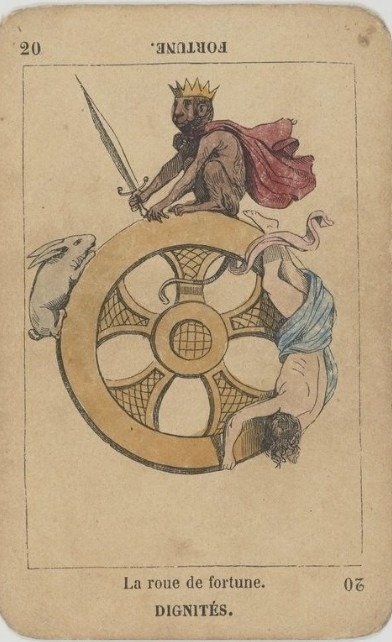
Levi wrote about this card in his 1856 book Transcendental Magic which was a major influence on other occultists of the time.
In the Oswald Wirth tarot, the two sides of the wheel represented creation and destruction while the sphinx is provided the balance between them.
The most popular tarot of the 19th century is the Waite/Coleman Smith deck and its these images the fool meets on his walk through the tarot.
This wheel of fortune has much in common with the French occultists’ versions. It incorporates figures from Egyptian mythology, although Waite did not believe the tarot had Egyptian origins, and retains the link with the story of Ezekial.

The jackal headed Anubis rises. Anubis was the god responsible for the opening of the mouth ceremony as well as weighing the heart of the deceased next to a feather. The weight of the heart determined what would happen next.
A snake or serpent descends. This is Set, an Egyptian deity who embodied wickedness. The Waite/Coleman Smith wheel retains the idea of a balance between creation and destruction, and the duality of good and evil.
The sphinx at the top of the wheel signifies Horus, Egyptian god of wisdom, life and death, as well as representing stability.

The wheel has four letters and there are a number of interpretations:
- TARO (for tarot)
- TORA (Hebrew for law or teaching)
- ROTA (Latin for wheel)
- ORAT (Latin for speaks)
- ATOR (for Hathor the Egyptian goddess of joy, childbirth and motherhood who also guided souls to life after death)
In between are the hebrew letters י-ה-ו-ה for YHWH or Yahweh. This is a reminder that the will of god lies behind the ups and downs of fate or destiny.
The spokes of the wheel carry the alchemical symbols of the four classical elements: mercury in the north for earth, sulphur in the east for air, water in the south and salt for fire in the west.

Waite took the corner figures from the four Living Creatures of Ezekiel. Top left is the angel (air), top right an eagle (water), bottom right a lion (fire) and bottom left has the bull or ox (earth). The four figures are reading books which symbolise knowledge.
The image has been replicated in many contemporary packs, some of which have added their own interpretations, for example the eight spokes of the wheel are said to represent the equinox points of the turning year.
Here is another image of eternal cycles; the summer solstice and winter solstice in June and December, and quarterly equinox points for Imbolc (February), Beltane (May), Lamas or Lughnasadh (August) and All Hallows Eve (October).
The wheel of fortune has also been aligned with the Buddhist principles of karma and reincarnation where the soul was immortal and each earthly life a result of actions taken in previous ones.

The fool is exhausted.
There’s too much to take in.
He’s almost half way through the major arcana. Each card has contained lessons. While the symbolism of the cards matters, it’s enough for now to focus on what the cards have to say.
Deeper study can come later.
Once the fool has reached the end of the major arcana, he will be better placed to understand.
The purpose of symbols is to trigger thoughts and feelings, to see previously unseen connections, in particular on this second line which is designed to trigger hidden elements of the unconscious self.
What lessons can the fool learn from this card?
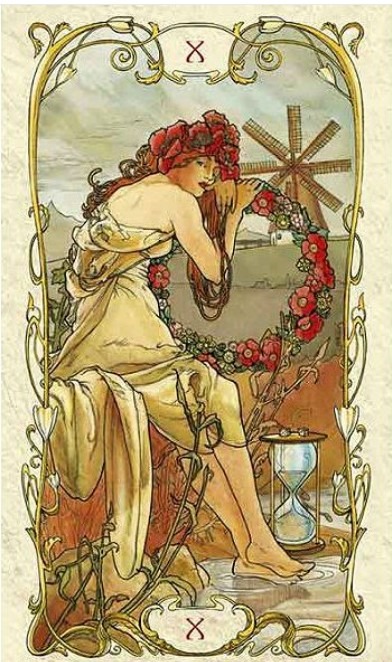
The wheel of fortune represents the literal ups and downs of life. Birth and death, creation and destruction, joy and sorrow, are all part of the pattern.
The wheel also reminds the fool of how everything contains within itself the binary opposite. To be born is to die. Good is defined by bad. What goes right is always the opposite of what can go wrong.
To live is to be caught within a circle of time. The passage of years can’t be stopped, but just as the world spins and we don’t notice, we often don’t see the wheel turning within our own lives.
Like the fool, we’re all caught in a complex navigation of negative and positive experiences.
The purpose of this card is to encourage a deeper look.
The wheel of fortune also connects with card 1, the magician, where the fool was shown the principles of like attracts like through the hermetic principle of as above, so below or every action has consequence.
The fool didn’t take much notice at the time. The cards were new and he’d only just started his journey. The wheel is there to remind him of foundational facts.
Life goes on regardless.
Nothing happens without a reason.
Life is a state of constant change but the tarot journey is about stimulating personal growth and awareness.
Some people believe the external controls them, making them victims of circumstance. Others take steps to detach themselves from the material world, to focus on adaptability and resilience.
The wheel of fortune is a reminder we’re the sum total of what we do, whether it’s making the same mistakes over and over, or being brave enough to open doors to new experiences. The fool realises he has the choice to fall apart or find strength to pick himself for a fresh start.
During his time with the hermit, he learned about stepping back from the helter-skelter of day-to-day life. To make time for himself. Be at peace with isolation, without distractions.
To understand the wheel is a similar experience. The fool realises he can detach from the continual process of movement, which up to now has always felt beyond his control.
Only by stepping back from the endless cycles of external influence can he make the next step on this journey towards himself.
The next card on his walk through the tarot is the archetypal figure of justice. It represents one of the cardinal virtues. We’ve already met fortitude in the strength card and prudence in the hermit, while temperance lies ahead.
Join the fool on his next step on a walk through the tarot, where the figure of justice awaits him.

images my own, or copyright free from wikipedia commons and https://pixabay.com/