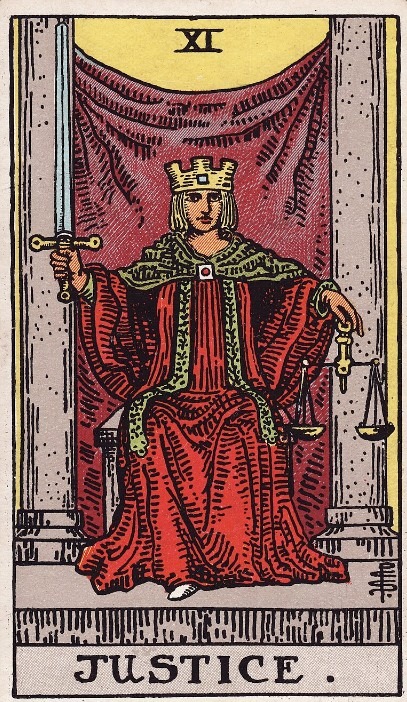
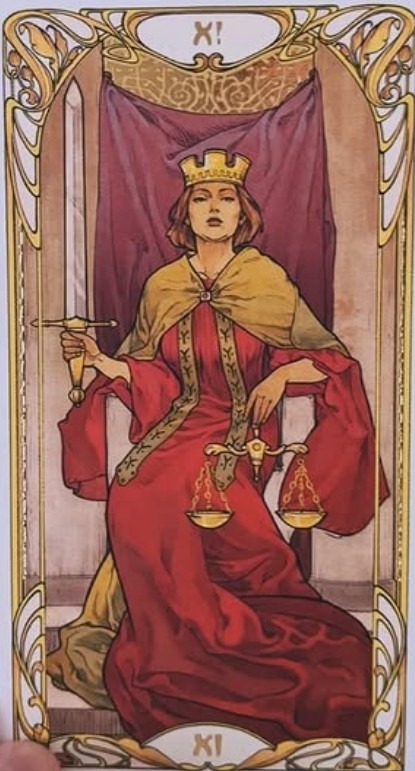
The fool has arrived at card 11, justice. After the raw truths of the wheel of fortune, with its rising and falling cycles of gain and loss, he feels back on solid ground. Truth matters. Rules and laws are an integral part of a functional society. How hard can this card be?
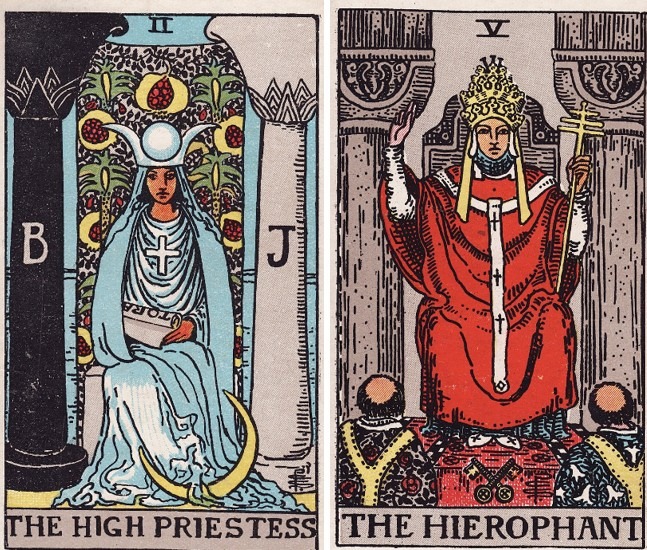
The pillars and veil are familiar. He saw them in the high priestess, while the hierophant also sat between two columns.
Excepting the lovers, everyone on the first row was holding something. Admittedly, no one had such a powerful looking sword, and the scales are new. The fool guesses they’re something to do with the balance between right and wrong.
If he was placing the cards he’d put justice next to the emperor who represented structure and power in society. The colours are not dissimilar and he’ll swear the veil matches the emperor’s sky.
Or because justice points up and down like the magician, maybe there’s a connection there. Afterall, one of the tools on the magician‘s table was a sword.
The fool is right to think about potential relationships between the archetypes he’s met, especially the magician and high priestess, but he’s forgotten two things.
The present path is taking him towards his unconscious self.
Justice, as card 11 in 3 rows of 7, is exactly midway through the major arcana.
This is a critical point on the fool’s journey and a useful time to step back for an overall view.
Think of the cards in two ways.
They can be used as a psychological tool to gain a better understanding of yourself, both conscious and unconscious layers, like a form of do-it-yourself psychoanalysis.
Lets talk tarot explains how this approach uses the cards to uncover the tripartite personality, whereby consciousness is formed and driven by the unconscious and subconscious parts of ourselves.
Discovering the roots of motives and behaviours, especially understanding why patterns of poor habits can be so persistent, is an essential part of personal change.
Or the cards can be understood as a process of initiation, designed to answer deeper questions, in a similar way to entering a religion or mystery group. Afterall, they have much in common.
Faith systems teach us we have outer and inner selves, usually referred to as body and soul. Material and immaterial. Once born into the physical world, we die and leave it behind while life for everyone else continues.
The mystery is what happens next.
Many people don’t or won’t accept the principle of binary selves. They retain a material, existential view which denies the existence of a soul or afterlife.
Using the tarot in this way is probably not for them.
Whichever way is chosen, the process is not easy.
There’s been times when the fool himself has not been fully aware of what each card represents but he has curiosity and so far, this has driven him on.
In the tarot, Justice stands for action with regard to inner awareness, hence her position in the centre of the spread. The purpose of this line is to delve deeper into our conscious actions.
To understand what drives and motivates us.
Justice is less about what we do and more about why.
The wheel of fortune represented cycles. Now justice offers an opportunity for greater understanding and wisdom with regard to the ups and downs of life.
Where ever we find ourselves in the present, it’s the result of everything done in the past. We’re the sum total of our actions and this card is about committing to personal responsibility for what we choose to do.
Unless the fool realises his own accountability for his life, there’s no point in going further.
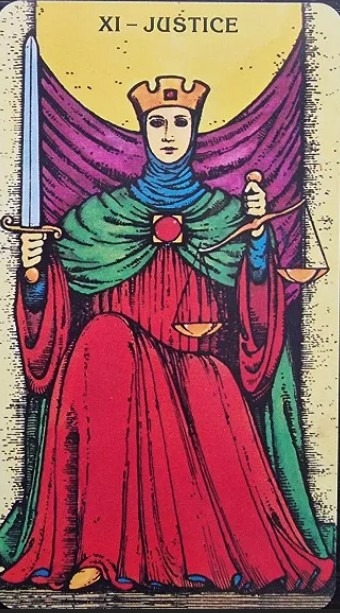
The veil is dividing him from who he really is. Justice is offering him opportunity to lift the veil and walk behind it.
Strength and the hermit have introduced the concept of inner awareness. Justice demands a response. She represents truth. The fool cannot continue unless he understands that whatever happens, he has to accept the only person responsible for his adult life is himself.
It’s the eleventh step and our fool has finally reached the purpose of his journey.
The principle of justice appears across cultures. In ancient Egypt the goddess Maat is portrayed wearing a feather. This is used by Annubis when he weighed the hearts of the dead against it in order to decide what happened to the soul.
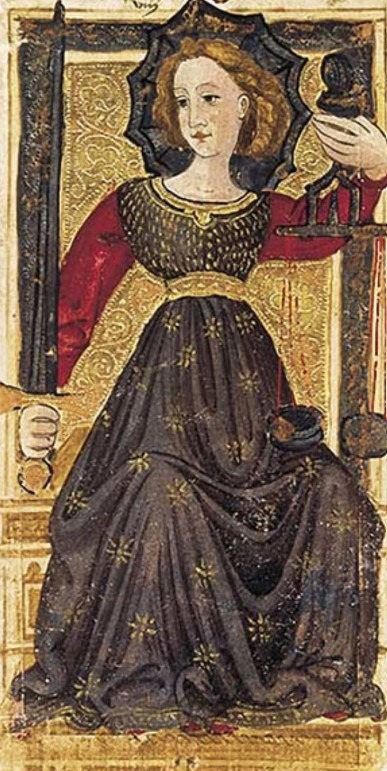
In ancient Greece, the goddess Themis controlled divine order as well as custom and tradition. Associated with the Delphi oracle, she is represented today as Lady Justice.
Her statue can be seen outside courts of law where she holds a sword and scales, and often wears a blindfold to emphasise the law is impartial, objective and beyond external influence.
In early Christianity, the archangel St Michael was pictured with a sword and scales. It was his responsibility to meet the newly deceased and decide on their future, whether they would go to heaven, hell or purgatory.
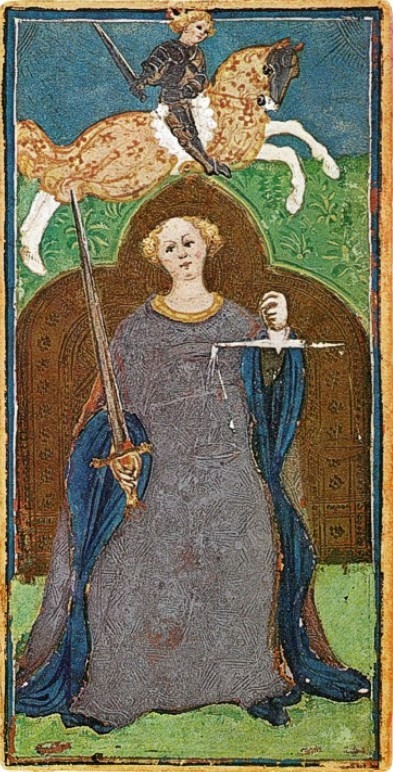
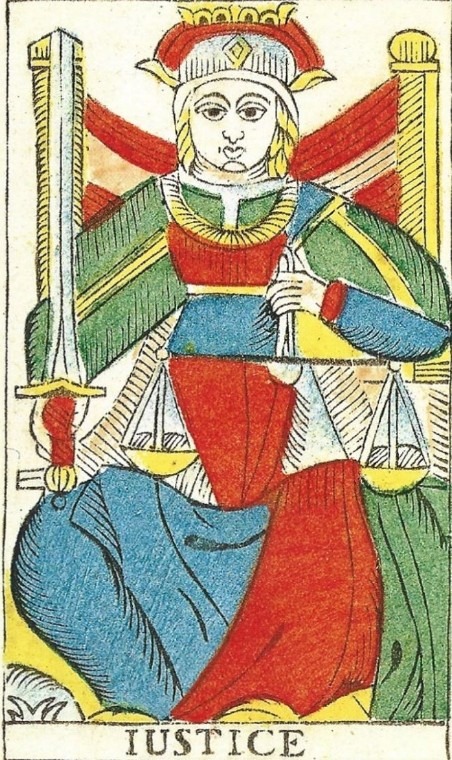
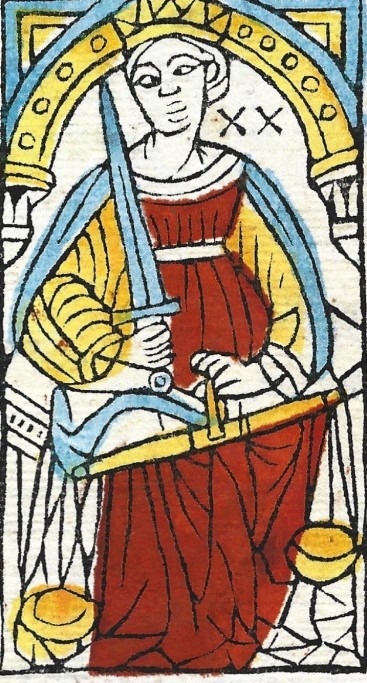
In one of the earliest tarot decks, the Visconti Sforza, justice appears with a white horse. This might be a reference to the verse in the bible;
“And I saw heaven opened, and behold, a white horse; and he that sat upon him was called Faithful and True, and in righteousness he doth judge and make war.” (Revelations, 19:11).
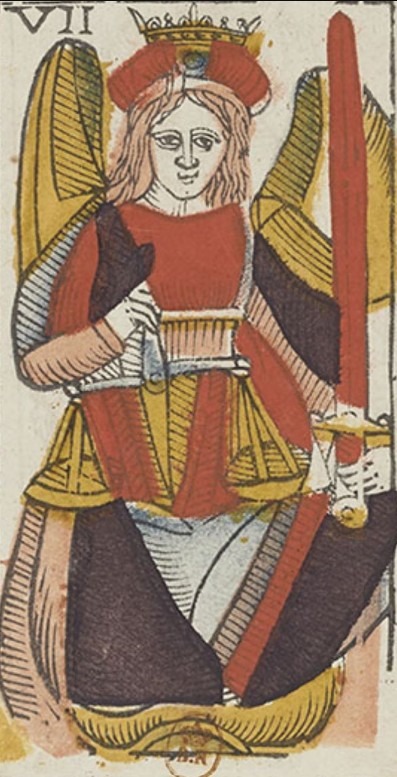
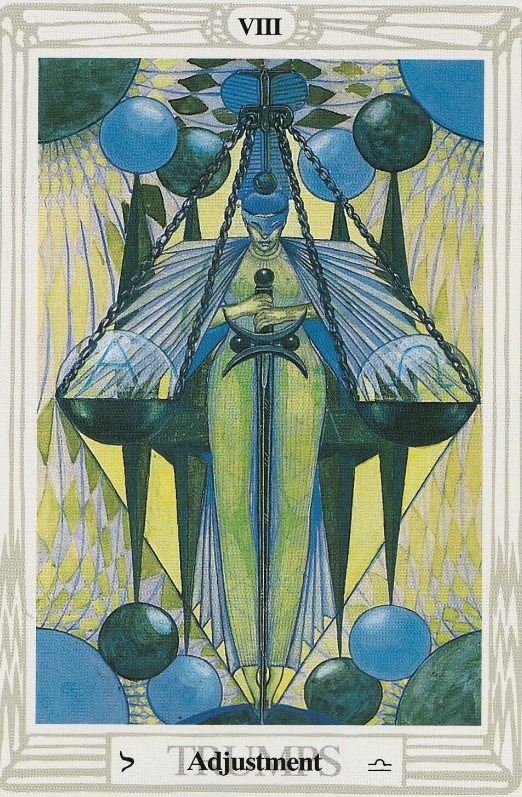
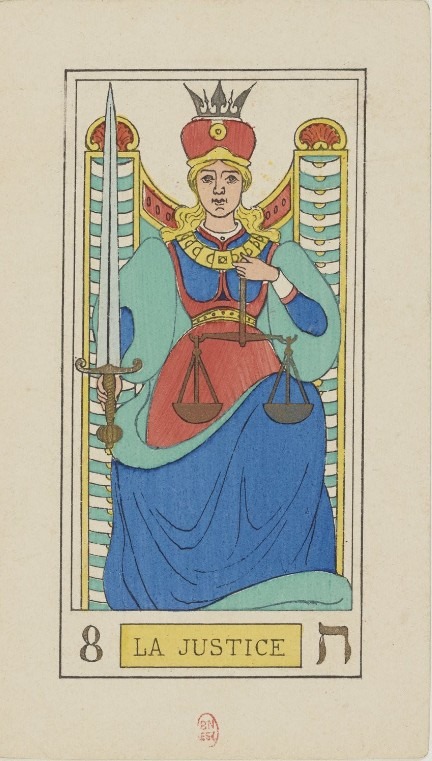
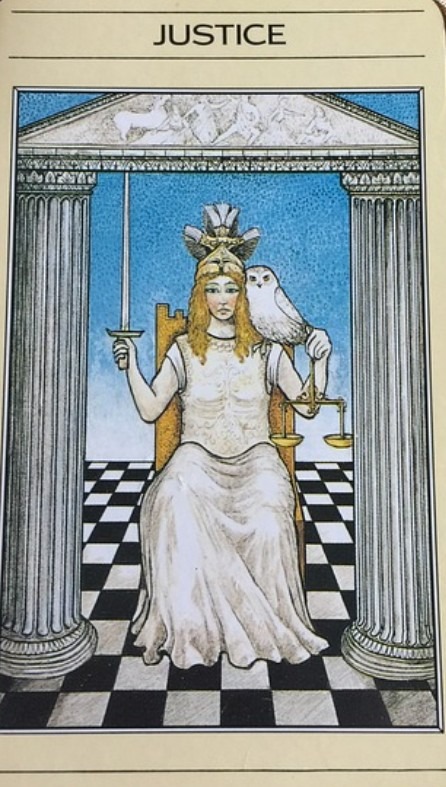
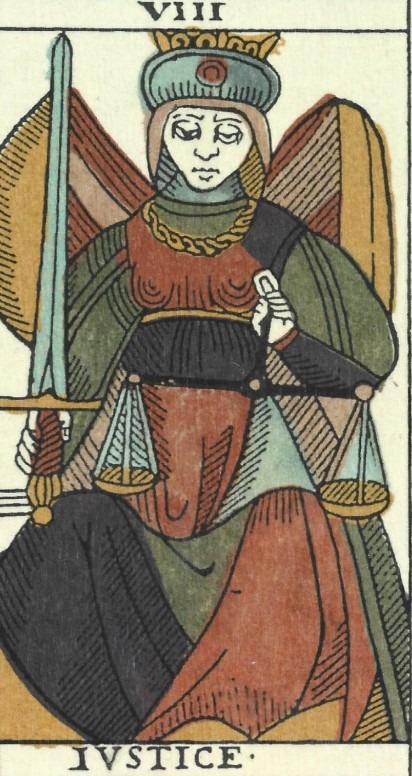
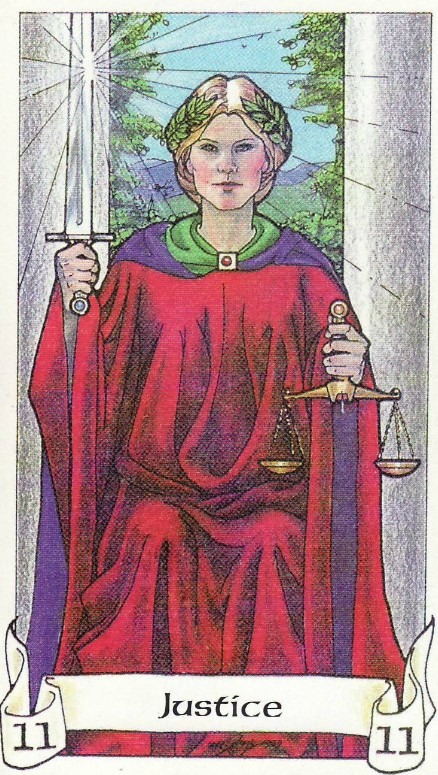
From the 15th century onwards, justice nearly always appears with a sword and scales. This is one of the tarot images which has changed little over time.
In the 17th century Jacques Vieville tarot decks, she has wings, a feature which continued to appear throughout the 18th century.
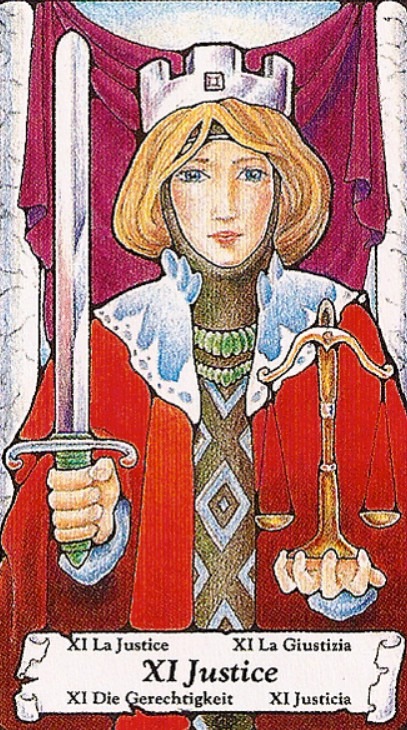
In the Marseilles-style decks, the wings are replaced with a high backed chair or throne. This was copied by the French occultists in the 19th century who stressed the values of organisation, rationality and social order.
In the Waite/Coleman Smith tarot, justice is not blindfolded. She looks right back at the fool. The balance of her scales is between inner and outer energy. Her veil shows the fool he has yet to find this integration.
There has been some progress though.
The fool has been shown the construction of his conscious world through the archetypal cards on line one.
He’s seen he has the internal strength for the next stage and the hermit offered ways in which a deeper understanding might be achieved, but the fool still has much to learn.
Action is needed. The wheel of fortune will continue to turn but justice controls the scales. The fool has to learn ways to remain balanced. To become the still point in a turning world, where everything around him continues to move.
Justice is a pivotal card.
It demands commitment.
The fool must go through the veil to progress. If he fails to understand how his actions create his world, and refuses to take responsibility for ensuring he stays on the right path, the journey ends here.
Lifting the veil is to fully step into the tarot.
The journey has been about raising awareness. Now is the point where the fool needs to know himself. To look deeper inside. See himself face to face. Find his own balance. There are some difficult cards ahead but he doesn’t yet know this.
Justice is a leap of faith.
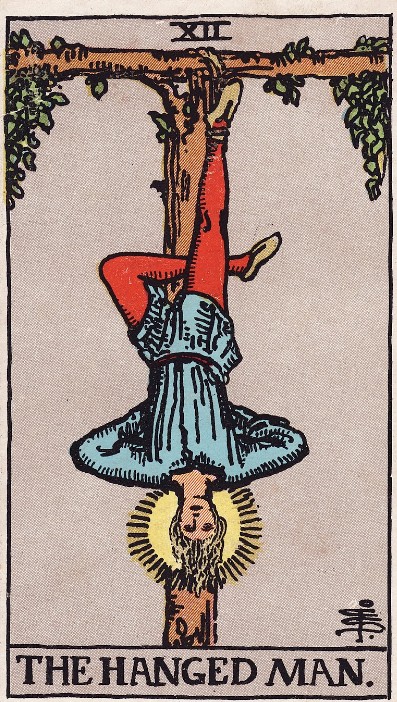
The next card is the hanged man. It represents the first step behind the veil.
The fool will need to make a sacrifice. Reflect on the principles of intuition and prophecy. Learn to trust the universe will ensure he’s in the right place at the right time for progress to happen.
Join us for the next step on this walk through the tarot.
images my own, copyright free from wikipedia commons or from https://pixabay.com/