
After the crisis of the tower, the fool arrives at card 17 to find the star. The falling tower loosened the hold of his ego and cleared the way for a fresh start. He is being shown the light.
With the veil torn away, the star offers direct experience of his subconscious. This card of alignment and integration offers the fool a potential opportunity for transformation.

Binary oppositions have been made whole.
Neither one thing or another, the fool can sense how every spark of life has combined into one single unity.
He feels at 0ne with the cosmos. He knows it won’t last but for the moment – just for a moment – the star represents a culmination of all that has gone before.
He waits…
The star card initially showed a woman holding a star. In the Visconti Sforza tarot she is dressed but in the Budapest tarot, both from the 15th century, she is naked.

It seems the star represents a number of different origin stories.
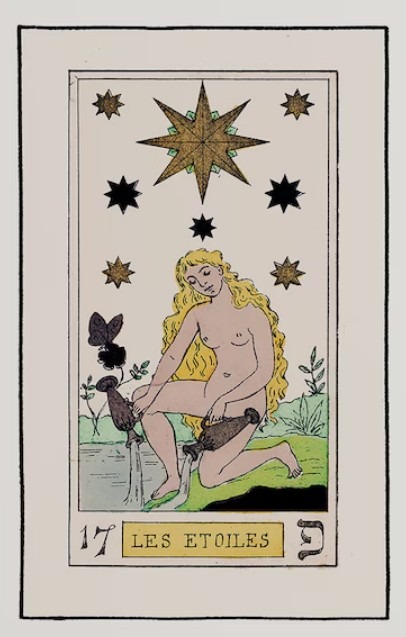
The cards in the 15th century Cary Yale deck, named after both the collector and the library where they’re held, have been associated with the Visconti decks (Sforza and Modrone) but in this version the star card shows a kneeling woman pouring water from two containers.
Although this has a look of contemporary tarot images for the star, it was unusual for the time.

The Rothschild tarot from the 15th/16th century depicts three men, possibly the three kings or magi from the bible’s nativity story.
This was also used in the 16th century d’Este tarot while the Minchiate deck shows a single crowned traveller riding a white horse and seeming to hold a gift up to a star.

The light from our nearest star, Proxima Centauri, takes over 4,000 light years to reach us but despite their distance, stars have long been used as navigational tools.
Their light in the darkness shows the traveller which way to go.

Historical packs from France focus on astronomy, as in the Jacques Vievil tarot and the Tarot de Paris.
The variety of themes suggest multiple different stories have influenced the card’s design.
Today, card 17 is portrayed in the style of the 15th century Cary Yale deck where a naked woman kneels beside water, pouring from two jugs with a range of stars in the sky.
The revival of this image can be dated back to the French Marseilles-style packs from the 17th century.

This image was retained when the tarot was adopted by the French occultists in the 18th century. Led by Antoine Court d’Gebelin and Eliphas Levi, the cards were linked to ancient histories from the early civilisations.
The woman in the star card was linked to the Egyptian goddess Isis while later occultists like A. E. Waite in his Key to the Tarot, connected the star to the sephirah Binah on the Kabbalistic tree of life.
Binah symbolises the earth mother, or principle of the divine feminine, and was the partner to Chokmah, her equivalent male partner.
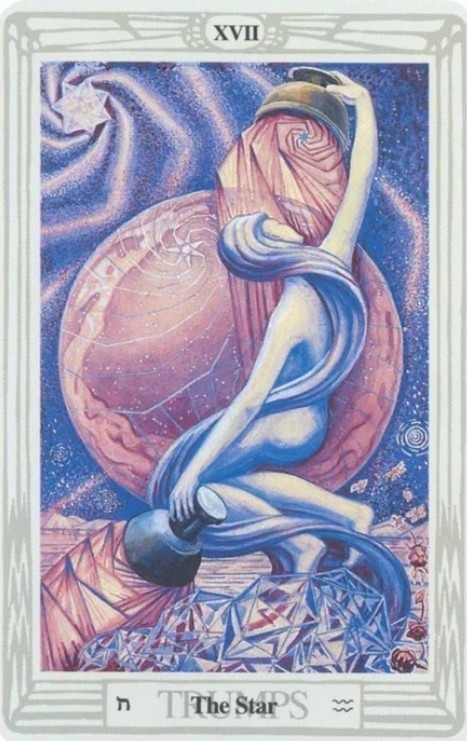
The stars on these cards were octagrams with eight points. This was associated with the Star of Ishtar or Inanna, a Mesopotamian goddess of love and war.
Bhuddists follow The Noble Eightfold Path, symbolised by an eight spoked wheel called the Dharmachakra.
Contemporary pagans use the circle divided into eight parts to show the points of the year; winter solstice, imbolc, spring equinox, beltane, summer solstice, Lughnasa, autumn equinox, all hallows.
Across cultures the number eight had spiritual significance, regardless of which path was followed.

The Waite/Coleman Smith tarot shows the water being poured back into a pool and onto the land, where it splits into five rivulets. Some say these represent the five human senses of touch, sight, taste, smell, and sound. They could also be the elements as in earth, air, fire, water and ether or the seven chakras.
Adding the streams from the two jugs gives seven, a number which always had a special significance, especially in the ancient world here seven was a symbol of divine order and spiritual completeness.
Some call the primary star polaris, also known as the northern star, while the seven smaller stars might be the pleiades or seven sisters. The constellation has long been used for navigation and in some cultures its appearance marked the cycles of agriculture such as the time to plant and to harvest.

In the background of the Waite/Coleman Smith card is a tree. This is thought to be the archetypal tree of life which has appeared across all cultures.
The tree supports an ibis or, as some say, a phoenix reborn.
In ancient Egypt, the ibis represented Thoth, who was depicted with an ibis head and known as the god of knowledge. The ibis has long been considered a sacred bird and symbol of communication, expertise and trust, while the phoenix symbolised regeneration and eternal life.
All the aspects of card 17 can be connected with balance and spiritual awareness, which in itself involves a duality between material and non-material selves.
What can the fool learn from the star?
He remembers the angel of temperance in card 14 at the end of line two, which followed death in card 13. The fool not only recognises the symbolism of water, he sees how the star card also follows a crisis, in this case the tower in card 16.
The star combines the female archetypes of the high priestess and the empress. The fool is looking directly at the pool of water behind the veil in the temple which represented the source of universal energy. A building block for life, the element of water is associated with emotion, intuition and understanding.
Water was also present in the empress card where it represented fertility, growth and the principle of divine femininity.
The star releases the inner life force which was absent from the chariot, causing it to be stationary so the chariot was unable to move. The presence of the star is an opportunity to release the brakes and move on.
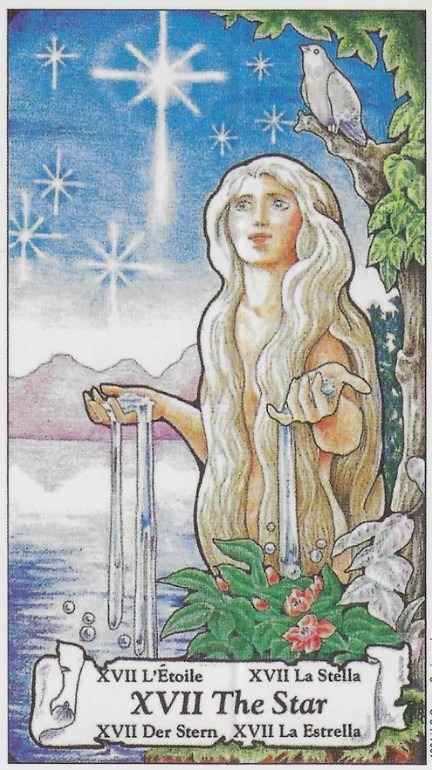
The fool remembers an eight pointed star was worn in the charioteer‘s hair while a similar star gave light to the lantern carried by the hermit.
The number eight on its side forms the infinity symbol or lemniscate, as seen on the magician and strength cards, where it represented infinity.
Following the chariot was strength. This had showed the fool he had the potential for inner courage and bravery. The star card now represents his transformation.
This is the fool’s opportunity for his physical, material self being to become an overall sensation of light and joy.
Psychologically, the star exists beyond the boundaries and controlling power of the ego. Neither vulnerable nor sexual, the naked woman is authentic and without shame.
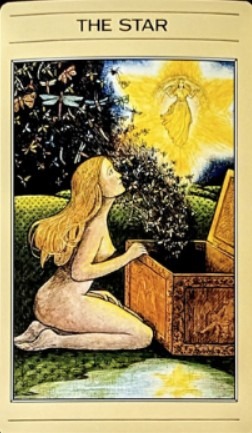
The star reveals the divine spark hidden within all life. It’s nature remains unknown and mysterious, unless the individual is prepared to do the necessary work to uncover it.
Water represents the life force flowing beneath material existence and the fool is seeing the secret source of this water for the first time.
In brain lateralisation theory, the left side is associated with logic and structure, language and math. The woman’s left hand is pouring water onto the land while the right jug refills the pool.
The right brain has been linked to emotion, intuition, dreams and imagination. She is refilling the subconscious self and ensuring a continuous connection with spirit or the divine.
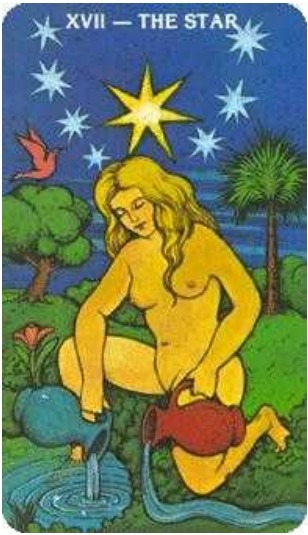
The star card represents the linking of the immaterial unconscious and subconscious with the world of conscious awareness.
What is seen and unseen have finally come together.
Everything the fool has learned on his walk through the tarot is being integrated.
The tarot has given him tools for insight but at some point he will have to return to the conscious world. He has stepped beyond the boundaries of ego but after his journey, the ego will still be there, with its preference for instant gratification and an easy time, one without the hard work of meditation or mindfulness.

Expert with excuses, the ego rarely matures. Instead, it remembers and represents the small child inside. The fool’s experience of the star is only a glimpse of what lies beyond life. The remainder of his years still need to be lived.
The water flowing onto the earth and back into the pool represents the union between his outer and inner selves. Energy is being released and the fool realises he truly is more than he thought.
The star card feels ecstatic.
He experiences a lightness of being.
The sense of walking on air.
A light burns inside and in this moment, everything feels achievable.

The fool realises how time and effort invested in lifestyles based on acquisition and status were not as important as he had once believed.
He remembers the sense of serenity and surrender around the hanged man. Here in the star, the peace of the hanged man has been made manifest.
The star is a card of reassurance.
It confirms everything is as it should be. The fool is exactly where he needs to be. He always has been. Everything in his life has worked together to bring him to this point.

Without this inner awareness of a divine connection to the cosmos, he clung to a sense of there always being more to achieve, especially in terms of material possessions.
It’s time to let go.
To surrender.
This new knowledge is telling him he can trust all will continue to unfold as it needs to. The ever turning wheel of fortune has to go down in order to rise, but whatever happens next, the fool knows the next downward spin will only be temporary.

The fool feels calm and peaceful.He doesn’t yet know how this learning will transfer to the material world, but the star has given him faith that it will.
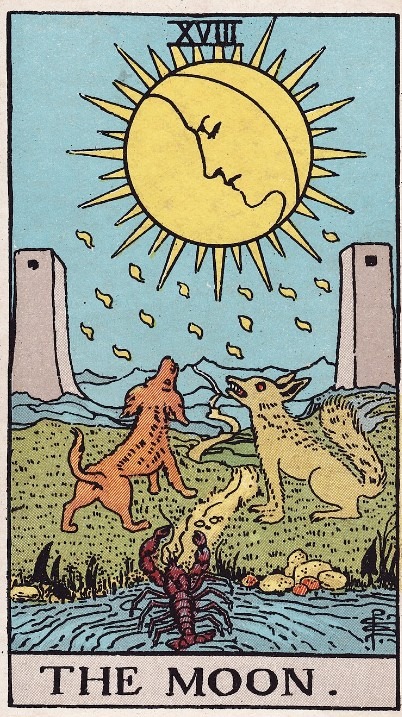
The next card the fool will meet is the moon. The star offers no direct path back to his conscious self. The moon will help him translate his new energy into forms he can take with him once the journey is complete.
Join us as he encounters the strange and mysterious forces of the moon.
images my own, or copyright free from wikipedia commons and https://pixabay.com/