After the peace of the star, the fool finds himself in a cold, bare landscape. He used to like gazing at the moon, always awestruck by how it seemed to hang effortlessly in the night sky.
Card 18 feels unwelcoming.
The moon is the card of deception and illusion. Moonlight turns the world into a place of shadow and mist while the night has always been associated with ghosts and scary monsters.
This card has evolved to become a symbol of nightmares, anxiety and irrational fear.
The fool wants to return to the comfort of the star but knows this is an essential step on his journey.
The moon has influenced all cultures. Feminised and worshipped, it represented cycles and rhythms. Ocean tides and female blood.
It’s been thought to affect human behaviour and the word lunacy comes from the latin lunaticus for moonstruck.
Many people garden by the moon, using the phases of waxing and waning to sow seed, take cuttings and harvest.
Every culture had a moon god or goddess.

In ancient Mesopotamia the moon god was called Nanna while in ancient Egypt it was the goddess Isis.
The Greek Selene and the Roman Luna were moon goddesses while Artemis and Hecate were also associated with the moon.
Today the moon’s feminine side represents the triple goddess, the maiden, mother and crone phases of a woman’s life.
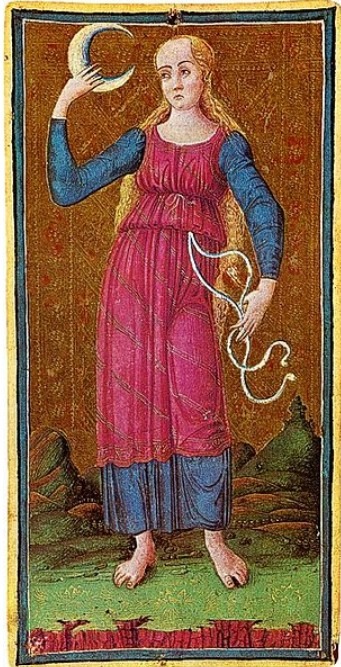
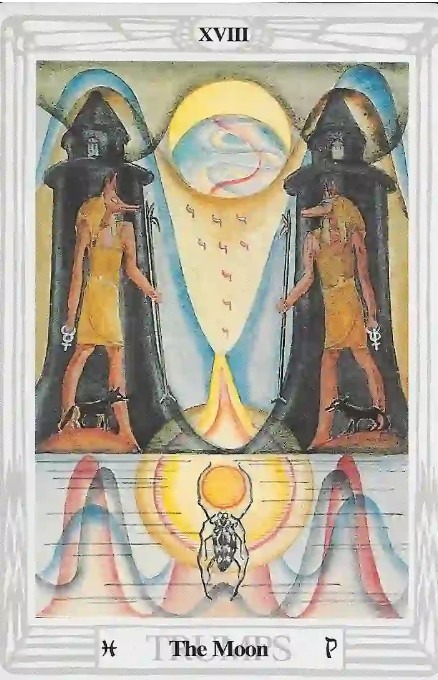
Early tarot from 15th century Italy had different ways to show the moon.
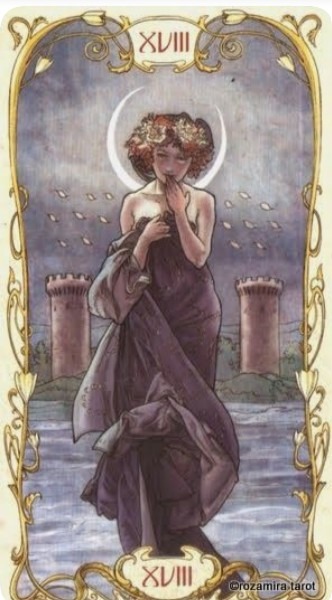
In the Visconti Sforza tarot, a woman is holding up the moon. She’s thought to be the ancient Greek goddess Artemis, known by the Romans as Diana, a virgin huntress who lived in the forests and hunted below moonlight.
Like the star card, there seems to have been multiple origins for the card.
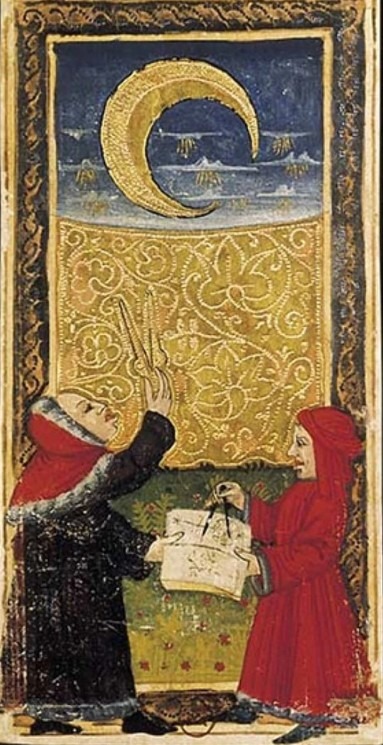
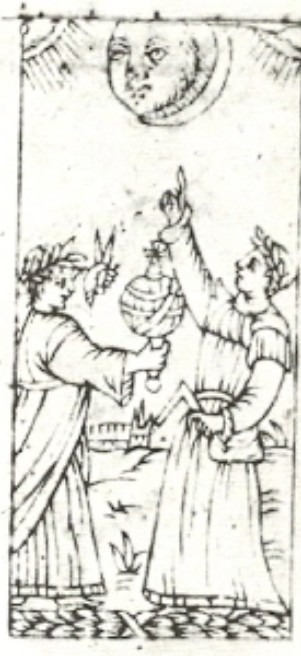
In the Charles VI tarot also from the 15th century, the moon card shows two astronomers pointing at the moon.
The Bolgnese tarots from the 15th to 18th centuries, such as the Al Mondo tarot, also illustrate the moon card with astronomy, as does the d’Este tarot from the 16th century.
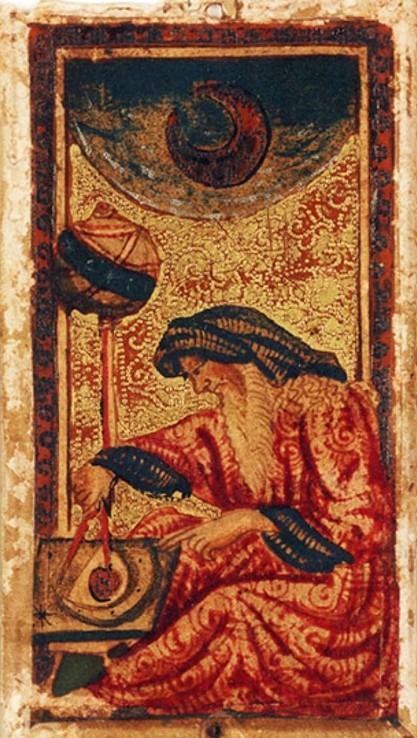
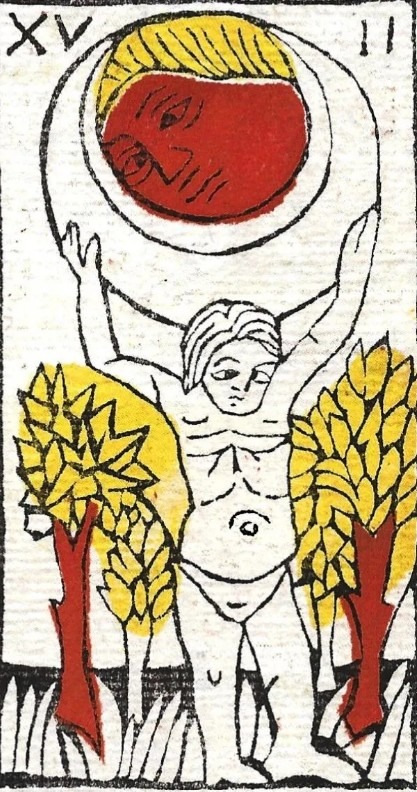
In contrast, the Budapest tarot from the 15th century shows a man holding up a moon which has a face and both quarter and full faces, an image reminiscent of Atlas who was punished by Zeus to hold up the sky for eternity.
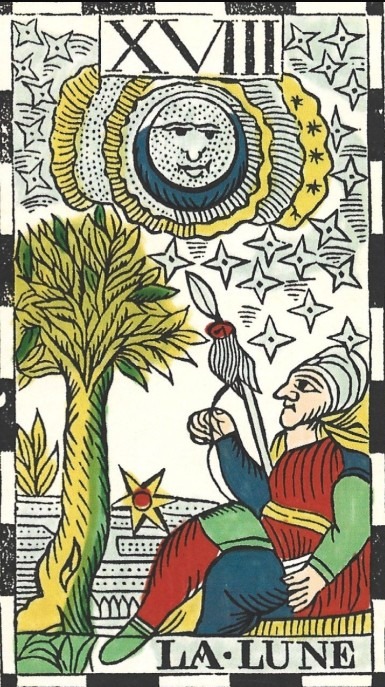
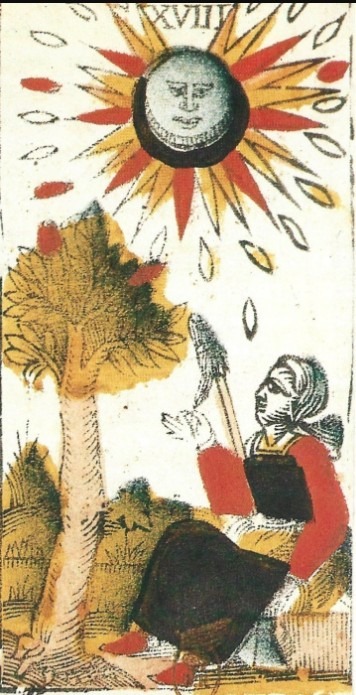
The card changed again in the 17th century with the Jacques Vievil tarot which has a large moon shining on a mature woman with a distaff in 1650.
This image was copied in the Vandeborre tarot a century later and continued in the Marseille-style moon cards.
The woman has been linked to Clotho (the spinner), who, alongsideher sisters Lachesis (the allotter) and Lachesis Atropos (the cutter) were the three fates or Moirai from ancient Greek myth who spun, measured, and cut each individual life.
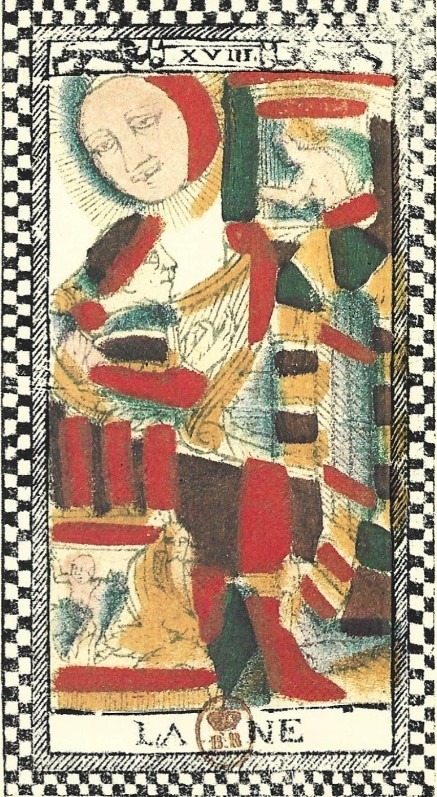
The Tarot de Paris, c1650, uses a different image. Here a man is playing a harp to a naked woman who stands on a balcony while the face of the moon looks down from the sky.
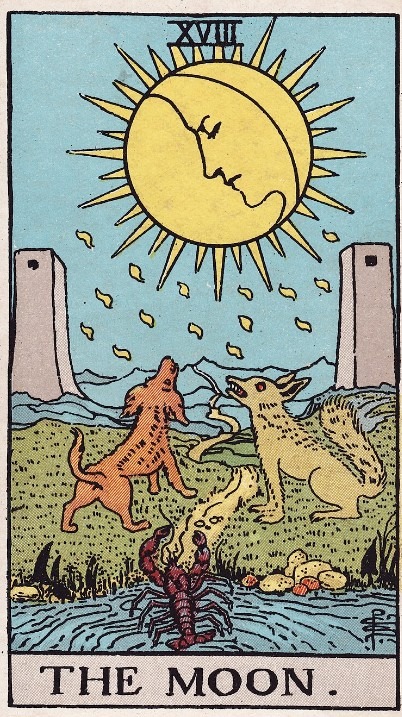
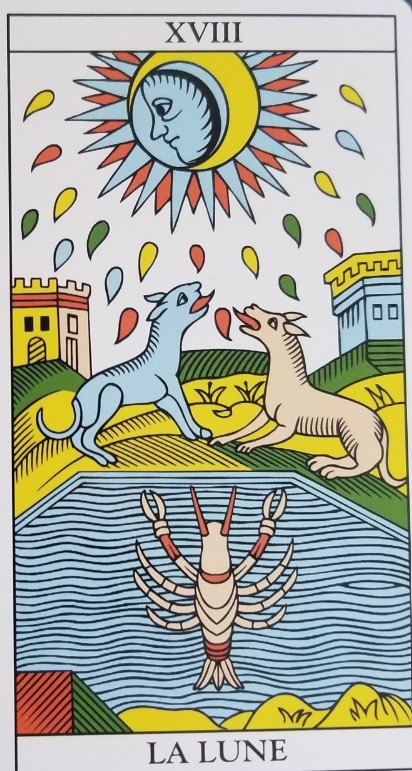
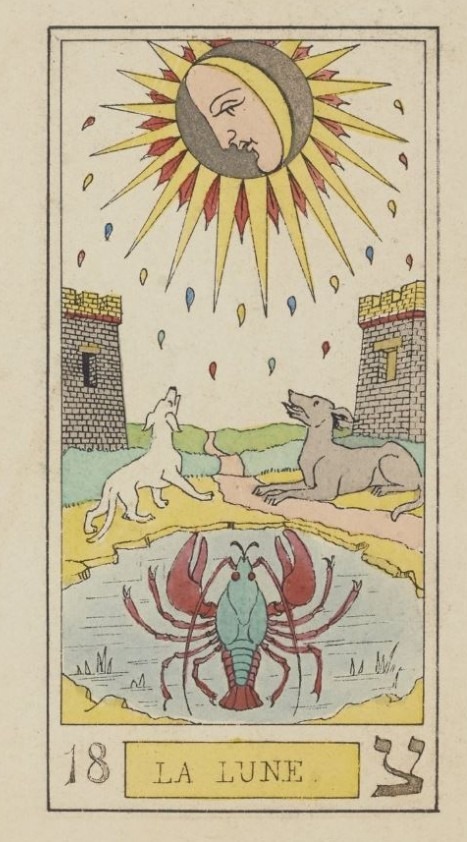
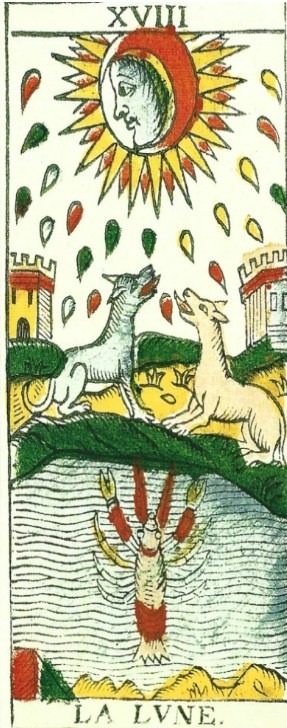
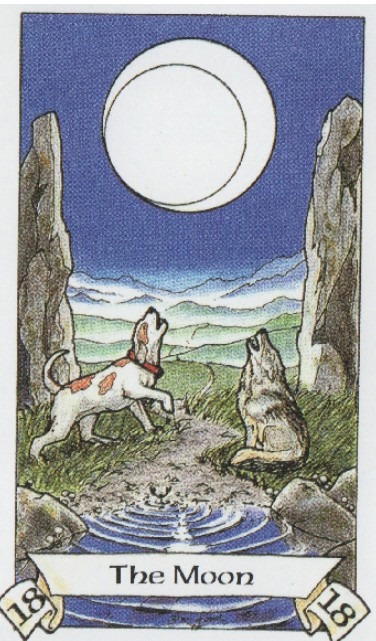
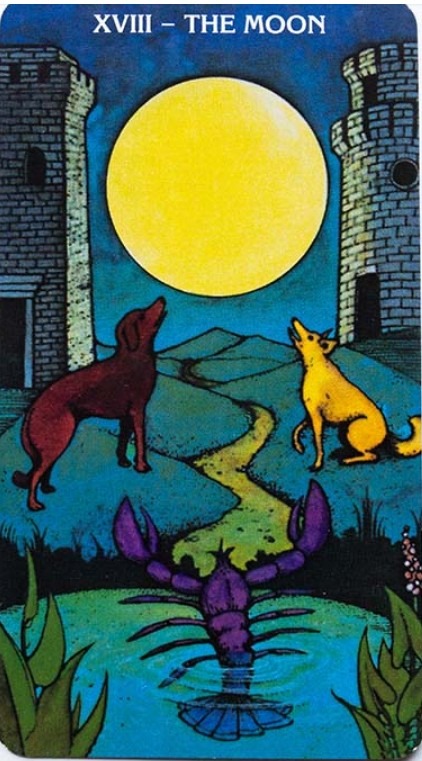
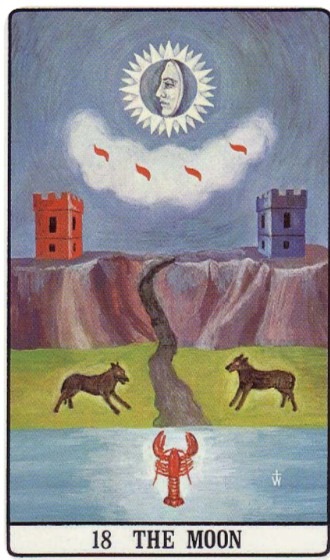
The majority of the French Marseilles-style cards showed a crayfish emerging from a pool of water, with a howling dog and wolf.
They also retain two towers or pillars in the background while drops of rain or blood fall from the sky.
In the 18th and 19th centuries the French occultists focused on the moon as symbolic of negative forces. They claimed it represented the world of unconscious thought and home for primal forces which are rising to the surface.
Their tarot designs have the crayfish emerging from water alongside the dog and wolf, one domesticated and the other wild, symbols for the opposing forces of body and mind.
The Oswald Wirth tarot from 1887 combined the key esoteric beliefs of the time. For Wirth, the moon was a terrible place, full of swampy marshes. The dog, wolf and crayfish stood for the conflict between the primordial forces and the chaos out of which the early universe was created.
The moon offered a glimpse into this world of foundational powers where balance had to be found between creation and destruction.
The Waite/Coleman Smith moon card retained these images.
The landscape looks cold and barren.
A path goes between the pillars but leads to nowhere.
The fool thinks he’s seen these pillars before.
They framed the high priestess, hierophant and justice while in the death card, they appeared in the distance, either side of a rising sun.
Here, they frame a moon which shows multiple phases.
The falling drops of rain or blood have become yods, hebrew symbols of divinity and the first letter of god’s name, yahweh.
The fool remembers yods falling from the tower struck by lightening where they signified the presence of god.
He turns his attention to the path leading towards the mountains which has no obvious destination.
Moonlight makes it impossible to know which direction to take, resulting in confusion and fear.
The crayfish represents the depths of the subconscious mind which is trying to climb out of the pool into consciousness but is struggling to get a grip on solid land.
As a result, the subconscious retains constant primaeval forces which all individuals must deal with.
In his Key to the Tarot, Waite says the card shows the life of the imagination. The only way to cope with the horrors it can manifest is to look for peace so the animal nature inside can be calmed and left behind.
This is what the fool has to do.
The star gave him a taste of divinity.
He’s seen the pool of universal energy being poured onto the earth and back into water, returning to its point of origin.
With the star, the fool had felt integrated.
Beyond the control of ego, he was whole and complete.
But the star was only a temporary respite.
There’s no direct path from the star back to the fool’s conscious self.
Consciousness needs a bridge for energy to flow in acceptable formats, such as disguising universal truths as mythical stories, or exploring a tool like the tarot.
On his walk through the tarot the fool has been uncovering his unconscious and subconscious selves.
The star offered direct experience of these inner layers without the distractions of ego. Now, the moon is shining a direct light onto all that is repressed in his psyche.
The fool has come a long way.
He knows how it feels to access his inner self.
He understands more about symbols and binary constructions.
For the fool, the moon represents the exposure of negative thoughts and translates them in ways which are more manageable.

He’s come face-to-face with his dark side.
The fool needs to use the knowledge he’s gained to uncover and understand its roots. Careful examination of fear leads to dilution or banishment.
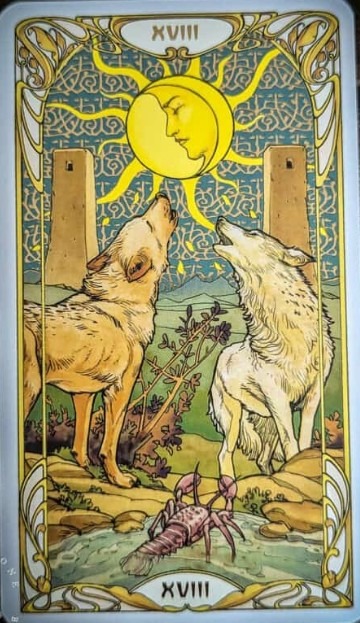
The dog and the wolf are howling, an archetypal expression of fear. They symbolise the tame and untamed, the civilised versus the more animal-like aspects of himself. These can surface through eruptions of internal nightmares, grief, and dread, sometimes making us seem primitive, almost inhuman.
Sometimes we have automatic, spontaneous responses to people and situations. They felt beyond our control and are often viewed with regret in hindsight.
Our reactions are conditioned from birth.
Some say fear of spiders or snakes is rational and derives from evolutionary genetics. There maybe genuine causes of fear but the only way to control it is through understanding it’s source. Therapy allows phobias to be treated but it will always involve meeting these fears face-to-face.
This is what the fool has to do.
Without the protection of the star, the moon is releasing all of the fool’s anxieties and bringing them to the surface.
The moon card is showing him that through knowledge and deep understanding, the negative and positive layers of his psyche can be integrated. By facing his demons he can diminish or banish them completely.
Once his inner layers work together in harmony, the fool will feel better. Function better. The yods remind him of this healing potential. They suggest reassurance and balance.
The moon is an object of beauty as well as a symbol for madness, but now the fool can look at the moon with new eyes.
To see it as a place where he faced fear and survived.
There will always be calm after the storm.
Behind the scenes, the high priestess has lifted the veil for the fool to step into the temple. Up until now, he’s learned to see the two sides of the binary constructions through which he understood the conscious world.
The star showed him everything was also one unified whole.
Everything still contained its opposite quality but now he sees this as completion rather than division.
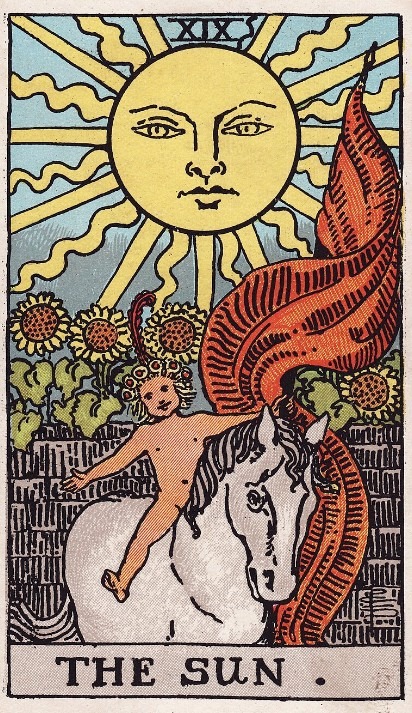
After the moon comes the sun.
Light of the world.
The fool has been tested.
The waters have stilled.
The crayfish has struggled out of the pool and the path in the distance now has a destination.
Card 19 is the sun. It will help the fool continue the process of integration by bringing everything he’s experienced up into his surface consciousness. How will he cope with this?
Join us for the next step on a walk through the tarot.
images my own, or copyright free from wikipedia commons and https://pixabay.com/