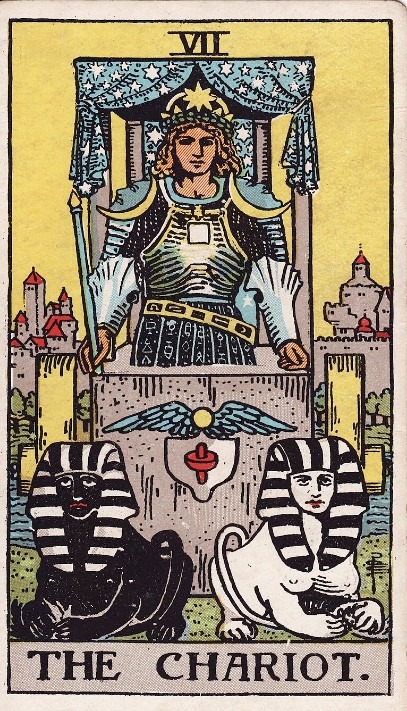
The fool has arrived at card 7, the chariot. This card marks the end of line 1 where the fool has been meeting the archetypes of the conscious world. He hasn’t seen a chariot before. It looks like a symbol of success, but the fools notices the chariot appears to be stationary. After his experiences with the previous cards, he’s learning what he sees might not be all it seems.
Chariots have long been associated with wealth and power.
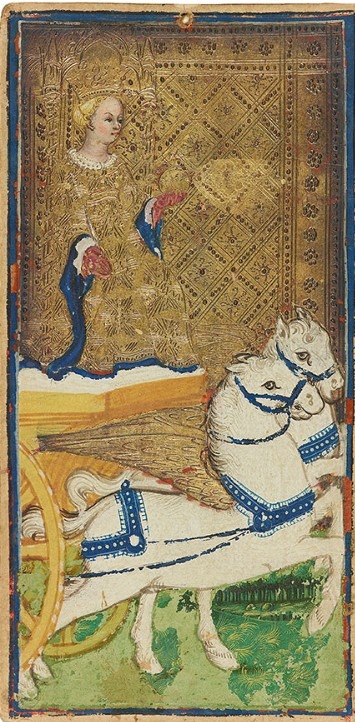
In ancient Rome it was customary to hold a parade after winning a war, followed by a display of chariot races to demonstrate strength and a confident ability to overcome obstacles. The races were part of festival days to honour the pantheon of Roman gods or prominent generals and senators.
Parades began as opportunities to demonstrate wealth and power.
They later became religious occasions where relics or models of saints were driven through the streets.
Medieval mystery plays told biblical stories and often began with a parade of wagons carrying the actors. The acting troupes would stop at various places to perform.
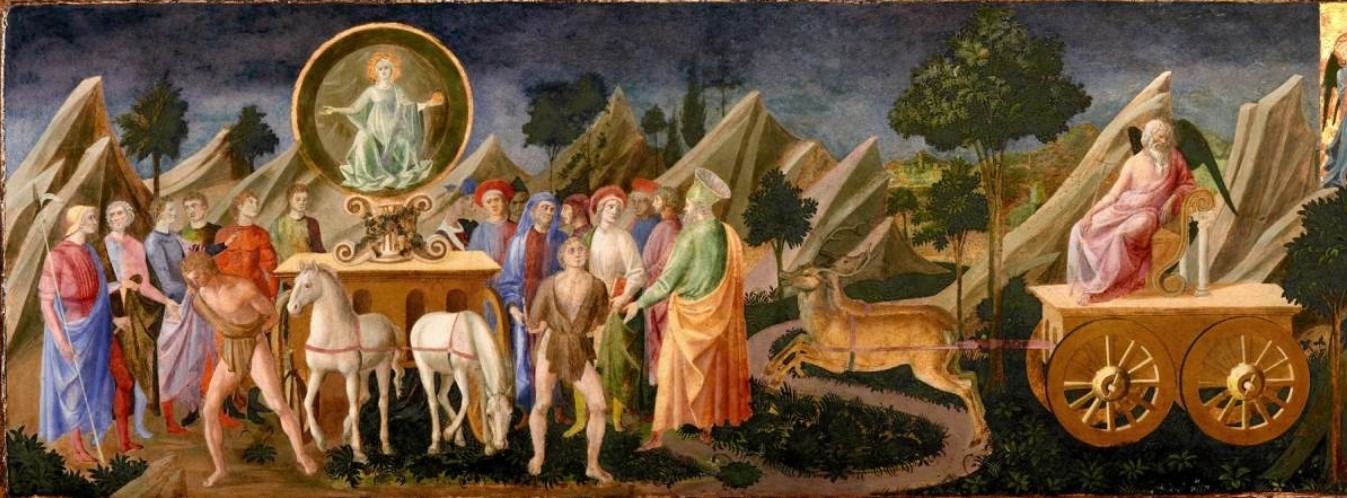
In 1351, a poem called I Trifoni (The Triumphs) by Petrach promoted the idea of chariot processions, each one related to Love, Modesty, Death, Fame, Time and Eternity. These were widely illustrated, for example in the work of Francesco Pesallini and it’s possible these images, and others influenced by Petrach, provided sources of inspiration for early tarot designers such as Bonifacio Bembo.
The inclusion of a chariot card in the first tarot decks demonstrates the popularity of public of parades, whether provided by ruling emperors, churches showing off riches and achievements, or as support for popular entertainment.
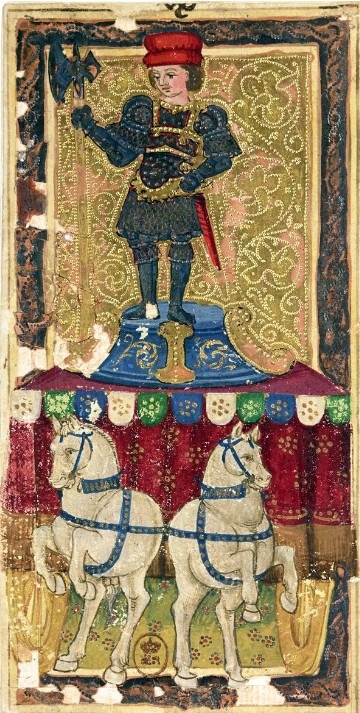
By the 15th century, when the first tarots were commissioned, chariots were well established as cultural symbols of success.
We still have parades today.
Examples include sport winners and astrounauts, where open top buses and cars have taken over the role of chariots.
The idea of a parade as an opportunity to demonstrate wealth, power and achievement remains constant.
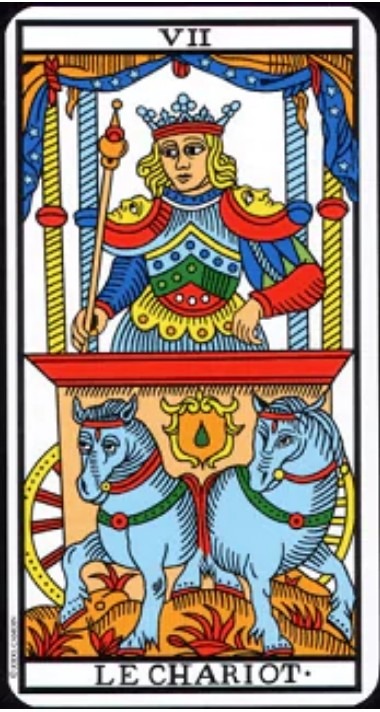
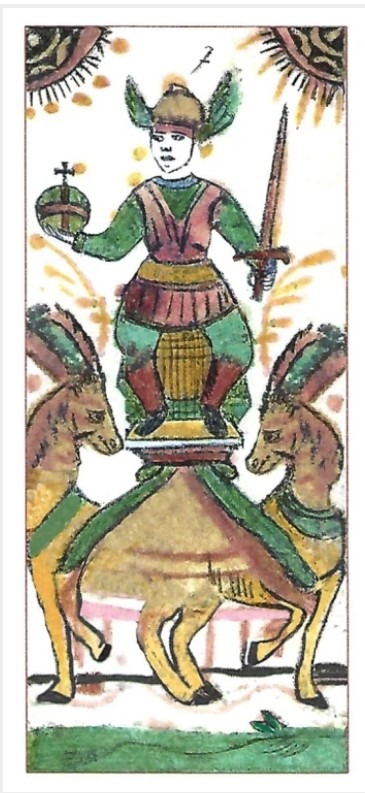
The Waite/Coleman Smith chariot is driven by black and white sphinxes. This duality and egyptian influence was absent from the early tarot decks. The Visconti Sforza, Visconti de Modrone and Charles VI chariots, all from 15th century Italy, are pulled by white horses.
Opposing colours were not introduced until the Marseilles style tarots were produced in France in the 18th century, while the spinxes were a result of the French occultists who adopted tarot in the 19th century.
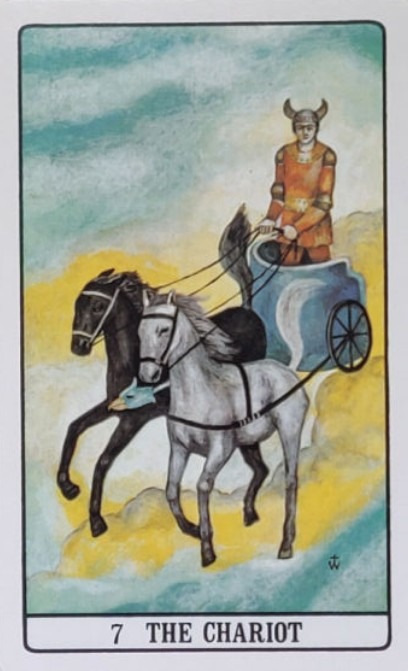
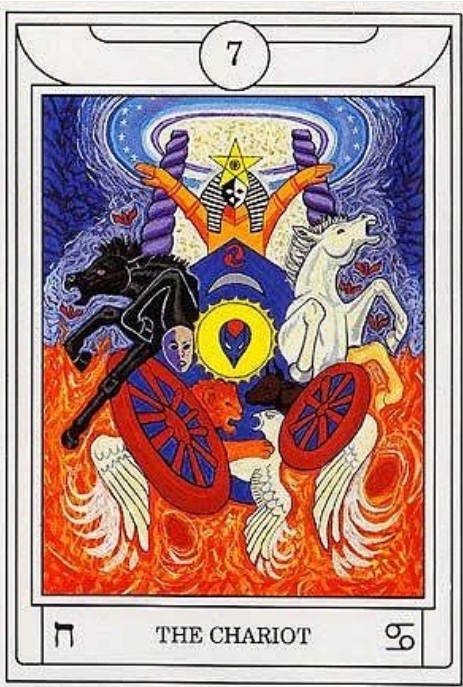
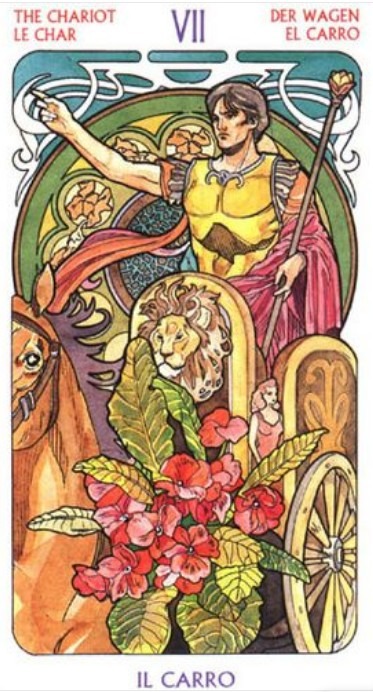
Contemporary designs have shown a variety of animals pulling the chariot, including lions, birds or a combination, but many modern tarots have retained the sphinxes.
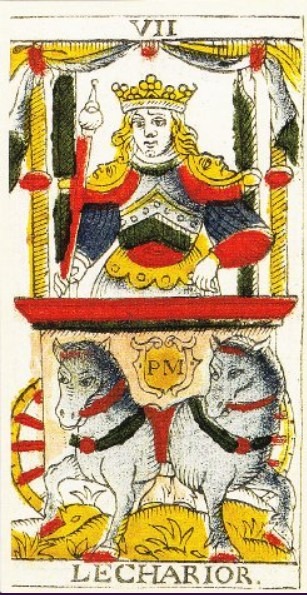
Some have linked the black and white hoises to the Phaedrus dialogue, written by Plato in the 4th century BC. Plato decribes a chariot with one well-behaved white horse, representing the spirit, and one black, more unruly horse which stood for material desire.
The role of the charioteer was to keep these opposing forces under control.
Under the influence of occultism, this representation of both material and spiritual aspects of the individual continued.
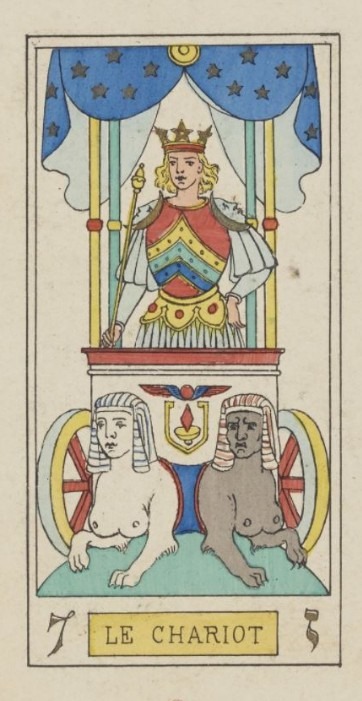
The fool is learning to see this duality. It was there in his first encounters with the cards where the magician and high priestess symbolised material and non-material realities.
Occultist Eliphas Levi, influenced by Antoine Court de Gebelin‘s claim the tarot had its origins in ancient Egypt, swapped horses for sphinxes to reinforce the Egyptian influence, despite the lack of evidence to fully support it.
There was a cultural fascination with Egyptian history at the time so it seems more likely the period was a source of inspiration rather than anything more factual.
The sphinx was a mythical creature who guarded the gates of Thebes and posed a riddle as a password. All who travelled to Thebes had to solve the riddle before they could enter the city.
Failure to answer the question what has four legs in the morning, two at noon, and three in the evening? led to death until Oedipus got it right. Man, who crawls on all fours as a baby, then walks on two legs, and finally uses a cane in old age.
Riddles can be used to remind us there’s often more to be found below surface appearances.
The chariot is not all it might seem.
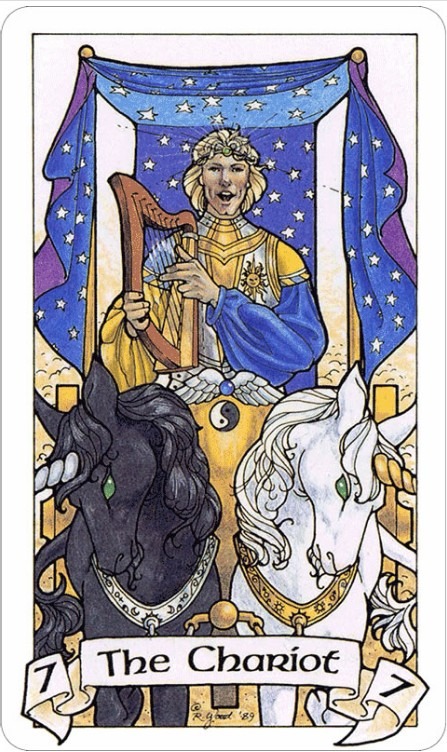
The Waite/Coleman Smith chariot has primary colours of blue and gold. The charioteer has long golden hair. He could be a prince or young king as much as a war hero.
There are quarter moons on his shoulders, symbols of instinct and intuition.
His crown is topped with an eight pointed star to represent the heavens, while the square on his chest suggests the four elements.
He holds a wand or sceptre, topped with what could be a pine cone or maybe the pineal gland the fool saw in the shape of a tree in the empress card.
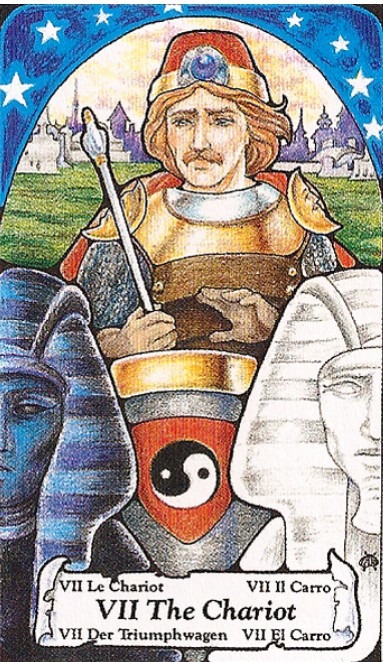
His armour is edged with gold and the chariot has a blue canopy covered in stars.
He stands alone, arms not touching the chariot sides.
On the front of his vehicle is the symbol a Lingam or the yin and yang, a sign of positive and negative energies in harmony. A pair of wings could be a symbol for the egyptian goddess Isis or represent flight, the ability to rise above problems.
The sphinxes look in opposite directions with no sign of reins or attachment. The lack of reins has significance.
The charioteer is using his will to hold two opposing forces, the outer and inner worlds, symbolised by the black and white horses or sphinxes. Physically it’s a card of strength but less about physical fighting and more about willpower used to balance the conscious and unconscious selves.
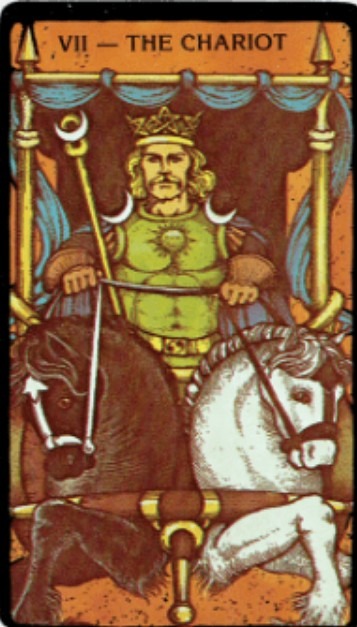
Behind him, the Waite/Coleman Smith chariot shows a walled city with a tree lined bank and river. There’s no sign of destruction.
The chariot itself looks like it has golden wheels but they dont appear to be moving. It has crossed the river and sits on the bank. The box of the chariot appears to be touching the ground. It looks like the charioteer is sitting in a concrete box!
Some say the wheels are in water while the body of the chariot is on land. It looks heavy and appears stationary.
Why would a chariot, built for speed, be still?
Here is someone who has reached physical maturity. He’s developed an outer persona or mask to cope with opposing forces and is in control of his desires.
However, too much emphasis on the material physical aspects of life risks the loss of inner qualities such as spiritual awareness.
The chariot represents the external world of language, communication and power alongside dominance and control, but the black and white sphinxes remind us of duality as well as puzzles to be solved.
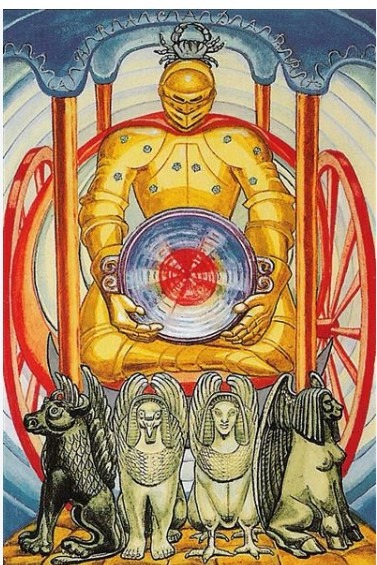
The chariot shows the fool how situations can be solved and controlled through will and the force of personality. Success connects to hard work and determination, but the duality of the sphinxes also represent opposing forces.
An adult who has become successful in life can control their feelings and direct their will to what seems important.
However, sometimes this sort of willpower is not enough.
The fool needs to be aware of the spiritual as much as the physical sides of himself.
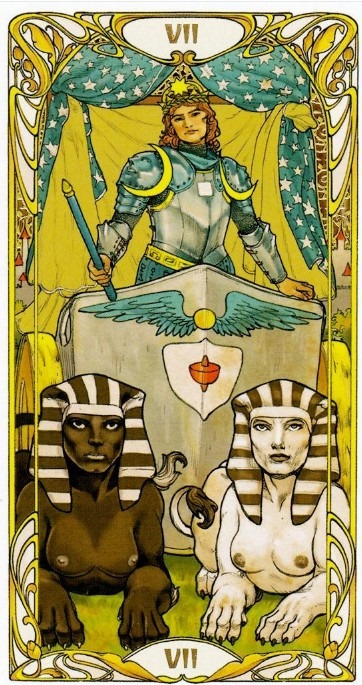
chariot from the Golden Art Nouveau tarotTo look inside as well as outside.
Those who ignore the hidden, more intuitive aspects of life can only succeed materially. The charioteer’s physical success is dependent on his outer strength but he has reached the point where there is no further to go.
This is a crucial card.
It can mark the stopping point or a conscious decision to change.
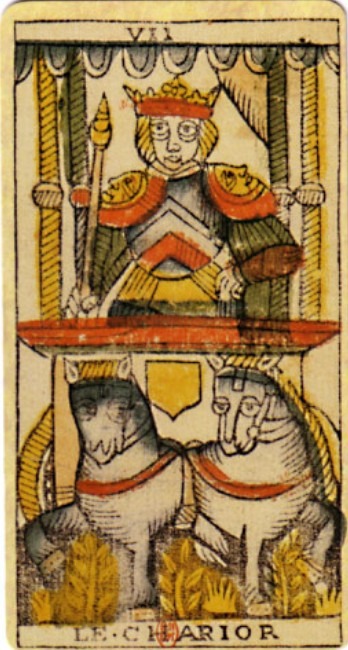
The previous six cards have opened the doors to this choice.
The fool has encountered the foundational archetypes and archetypal situations we all have to face and understand. He’s met the magician and high priestess who showed him the power he has to uncover the hidden aspects of himself.
The empress, emperor and hierophant demonstrated how the conscious world is structured in ways he needs to recognise and come to terms with in order to progress.
The lovers represented the first steps towards independence, the importance of choice and how the force of desire has the power to open up new ways of being.
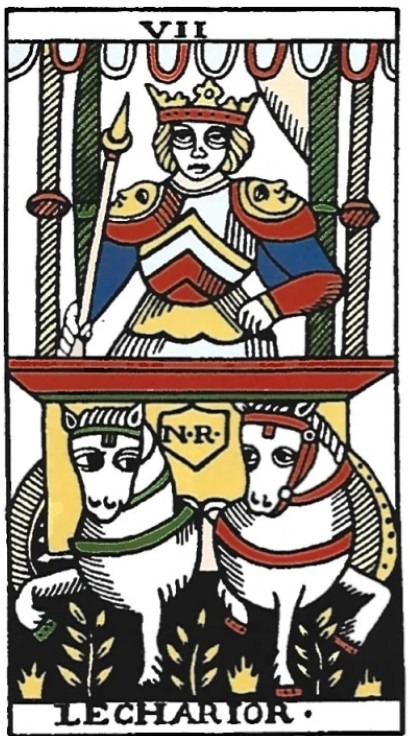
Positive energy and determination to succeed can be enough and many people are content to stop at the chariot stage. They see anything to do with the unconscious as unnecessary and dismiss any ideas of internal belief and faith in higher powers as invisible and bigger than they are.
For them, the external world is all that matters. Success equates with the visible representation of wealth and status. Any potential for greater understanding is not being realised and they don’t really care.
There’s no further to go.
It literally is the end of the line.
The fool has to make a decision.
He can continue his journey.
Or now he’s met the founding archetypes on line one, he can go back over the cards again, knowing they’ll feel a little less strange this time around.
Alternatively, he might decide enough is enough and return home.
The option to leave feels unrealistic. The journey is only one third done but his eyes have been opened. If the fool chooses to abandon his journey, there’s a risk he won’t fit in when he arrives back to his starting point. If was his difference that motivated the desire to leave home in the first place.
These cards have the power of attraction.The fool is nervous about moving onto the second line of the unconscious but knows if he gives up now, he’ll always be wondering what lay ahead.
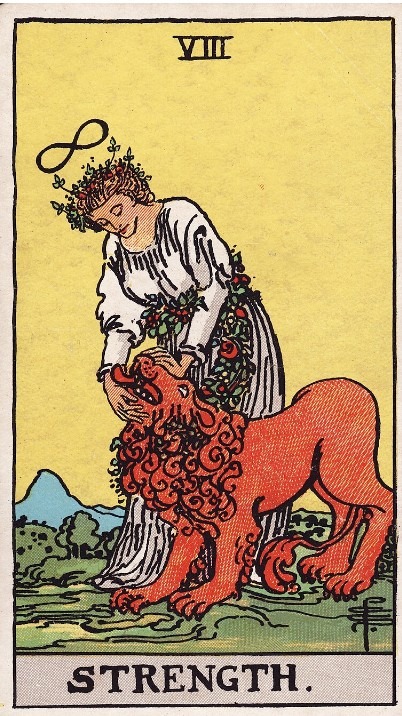
Should he decide to continue, the next card he’ll meet will be strength, and the fool already knows deep inside this is the right choice.
Join us for the next step on a walk through the tarot…
images my own, or copyright free from wikipedia commons and https://pixabay.com/