
The fool has met card 5 the hierophant, who looks like a high ranking bishop or pope. The card appears religious and the fool is reluctant to face him. As a child he was dragged to church for long sermons and remembers feeling bored and irritable. His first thought is to walk by but something catches his attention.
The men kneeling at the hierophant’s feet have robes with red roses and white lilies. The fool remembers these from the magician. He also sees the two pillars and wonders if there’s a connection with the temple of the high priestess.
So he pauses and waits…
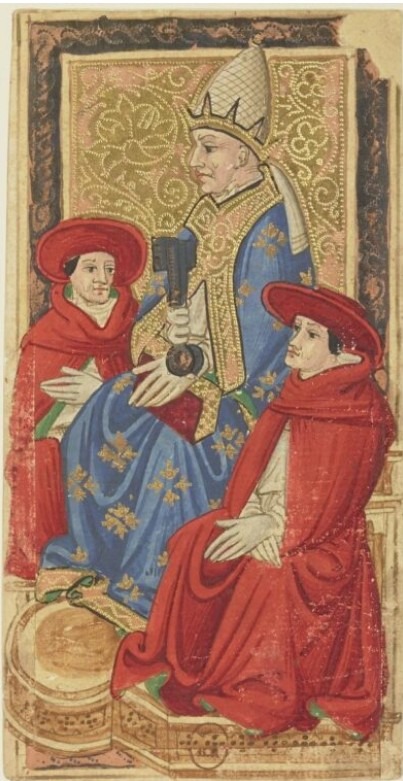
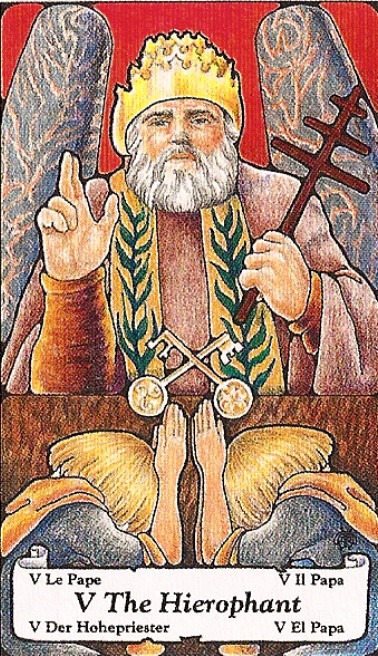
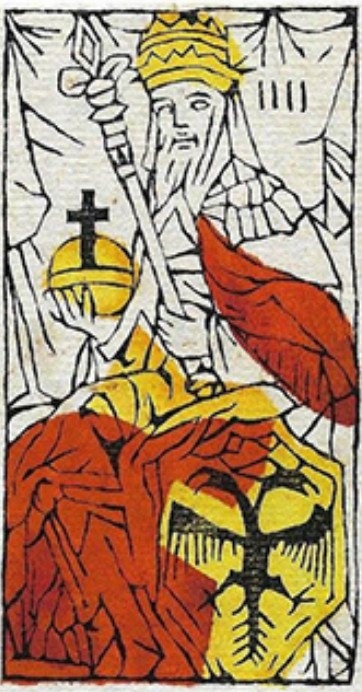
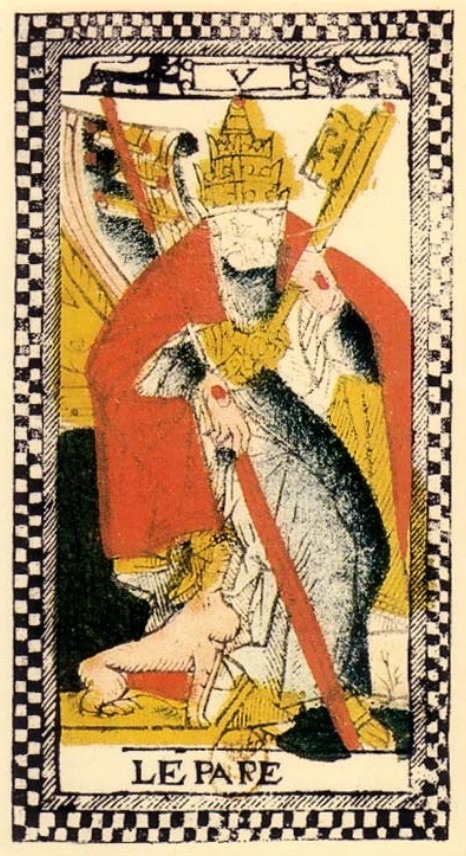
Early tarot decks called this card the pope. In Italy, the pope was gods earthly representative. A military force as well as a spiritual one. Whoever sat on the Vatican throne had control over the papal states as well as a papal army to defend them.
This gave the pope equal or greater power than any emperor.
Popes in the 15th century had political influence and wealth alongside being head of the catholic church and spiritual leader of the population.
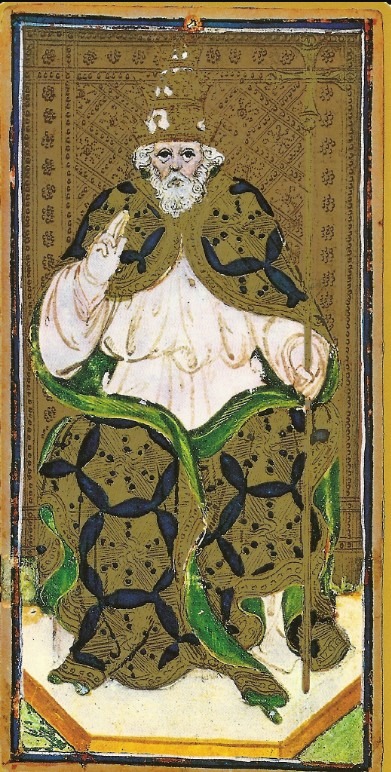
It’s hard to imagine today the extent to which church was an integral component of social structure. The pope not only had the highest status in the land, he also had control over the Holy See, interpretation of scripture and a long established inquisition whose role was to root out heresy and heretical ideas.
We’ve seen how the major arcana images of early tarot, such as Visconti Sforza and Visconti Modrone, provide a snapshot of cultural and political ideologies from the 15th and 16th centuries, and how the high priestess was originally known as papess, the pope’s female equivalent. Like both high priestess and empress, many of the major changes in interpretation happened in the 1700’s with the rise of interest in occultism.

The name change of this card is attributed to Antoine Court de Gébelin who believed the tarot had much older origins than 15th century Italy.
De Gébelin renamed the pope and popess as le grand-prêtre (high priest) and la grande-prêtresse (high priestess) while fellow occultist Eliphas Levi called this card the grand hierophant.
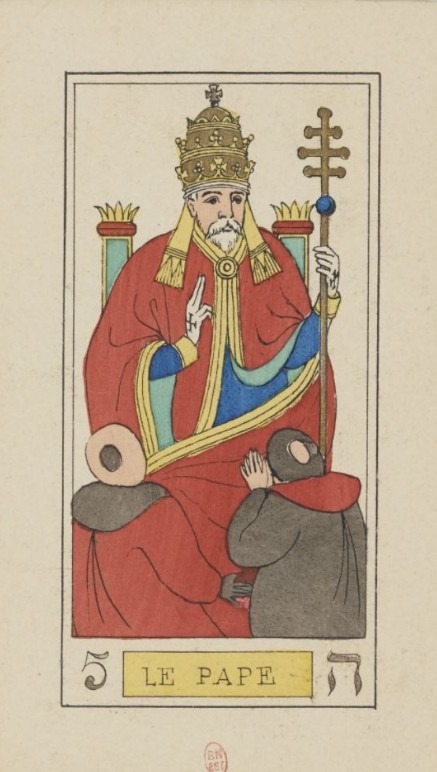
The word hierophant comes from the ancient Greek for holy (hiera) and to reveal (phainō). Secret sects such as the eleusinian mysteries were popular in ancient Greece, where the word hierophant was used to denote the leader or high priest of these groups.
The high priest was the translator of all sacred mysteries, the intangible and unseen.
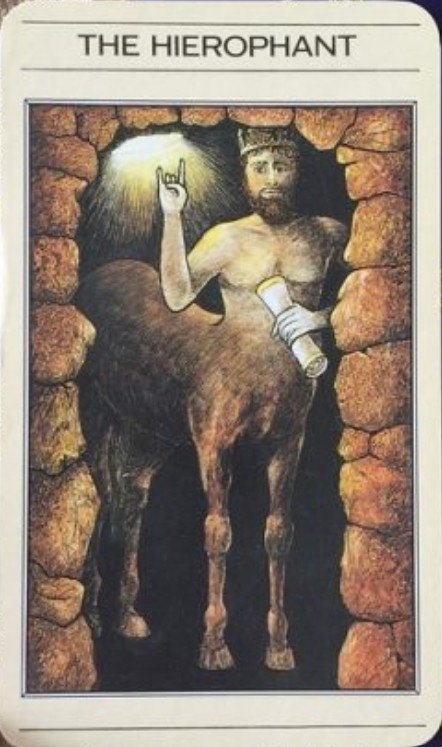
The mythic tarot portrays the hierophant as Chiron, the centaur from greek mythology, who Homer portrays in the Iliad (11.831) as wisest and justest of all.
High priests in ancient Mesopotamia were called the En.
In in ancient Egypt there were the high priests of Amun.
Zoroastrianism and older Iranian religions had the magi, while Vedic religion, the precedent to hinduism, was presided over by Pujari or Archaka.
In Chinese Taoism they were daoshi and Japan has their own Kannushi.
The archetype is common across all cultures.
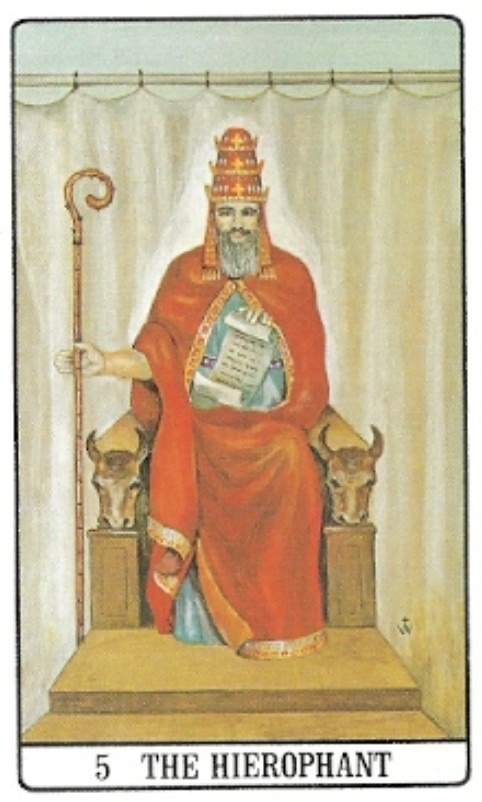
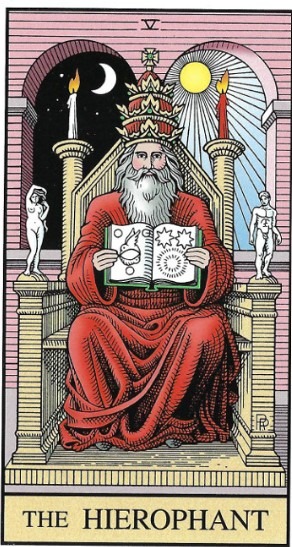
In the Waite/Coleman Smith hierophant a man sits between two plain pillars, similar to the high priestess, but lacking their black and white duality, while the throne depicts the papal keys, known as the keys of heaven or St Peter’s keys (Matthew 16:19).
Keys are used to open locked doors and one of the functions of this archetype is to be a teacher, in particular on the subject of spirituality like a modern day guru or spiritual philosopher.

He wears a rich papal crown. In his left hand he holds a golden sceptre or rod (named triple cross by Waite) while the other is raised in a traditional blessing or benediction.
The hierophant is dressed in red and white, colours mirrored in the red roses and white lilies of the robes worn by two men who kneel before him.
The fool has recognised these flowers from the magician where they grew freely all around. But whereas the magician showed the fool he too could manipulate the creative energy of the universe, in the hierophant these two men appear as supplicants, or initiates with the hierophant as the one who initiates.

Not via the baptism of babies or dust to dust funereal rites, but more as rituals for adults who’ve studied and explored different ways of thinking before coming to their own conclusions.
After the natural world of the empress, and socio/political environment of the emperor, the fool has come face-to-face with the hierophant who represents higher belief systems. The hierophant is an intermediary between what can and can’t be seen.
His function is almost shamanic in that he has access to the world of spirit and all that was considered divine.

As with all the cards in the major arcana, there’s also a reversal. Dogma and claims to absolute truths can lead to inflexibility and stubborness. By definition, to have faith is to believe without evidence.
Religion is often based on faith rather than science and the church has a long history of intransigence when it came to belief for example the inquisition, religious wars between catholics and protestants and its patriarchal views on contentious topics such as contraception or the ordination of women.
The fool remembers a local woman accused of witchcraft and the smell of fear. He’s reminded of lengthy sermons based on the principles of heresy and his parents’ beliefs in the bible as being the direct word of god.
He has never been a fan. The church’s restriction of belief was one of the reasons he set out on this journey to search for answers.
What can he learn from this card with its popish appearance which triggers memories of being the odd one out and feeling different.
The hierophant’s role is to show the fool he’s free to choose his own path. To find what resonates for him.
An archetype of spiritual belief, this card signifies the path rather than any generic destination.
The fool has to make his own decisions. He might not be ready yet but the hierophant is saying when the time is right he will recognise it and know the way forward.
This is a card of spiritual power; an eponym for all things occult and esoteric. While some might call this religion, for others it’s more abtruse and hidden.
The fool’s early experience of church didn’t fit. He felt the dogma was dodgy. There was an absence of comfort or joy. Now the hierophant is inviting the fool to find the path that suits him and take responsibility for himself, rather than slavishly following a doctrine he was born into.
The fool is only on card 5. It might be too early. He’s still far from the end of his walk through the tarot. He needs to take from this card an awareness that alternatives exist but to find them he must continue to study and learn.
The hierophant reiterates the magician’s lessons on the need to take action. To open the door. Take the first step.
He also pairs with the polarity of the black and white pillars of the high priestess, which symbolised duality and binary oppositions. What lies behind the hierophant is like the world behind the veil of the high priestess’s temple, it will always be there, waiting to be discovered.
The fool started his journey without knowing where it would take him. He felt the need for excitement. His life wasn’t enough and he wanted more, even though he wasn’t sure what that was.
The hierophant is the intermediary between the fool’s own burgeoning perception and the mysteries he doesn’t yet know or understand.
At any time he can return to card 5 to revisit and reflect. He needs lessons from the cards still to come before he can find what he’s looking for but like all the cards, the hierophant will always be there, waiting for his return.
The next card on a walk through the tarot is number 6 the lovers, a card which represents choice, in particular with regard to relationships. https://suewatling.com/walk-through-the-tarot-card-6-the-lovers/
Join me as we take the next step on this journey…

images my own, copyright free from wikipedia commons or from https://pixabay.com/
